Jared Kushner is looking for more than a quiet retreat or an investment opportunity: his island has “Israel” written all over it (2 articles)
The Kushner-Israel nexus behind the Albania ‘flamingo revolution’
By Eldar Mamedov, reposted from Responsible Statecraft, June 15, 2026
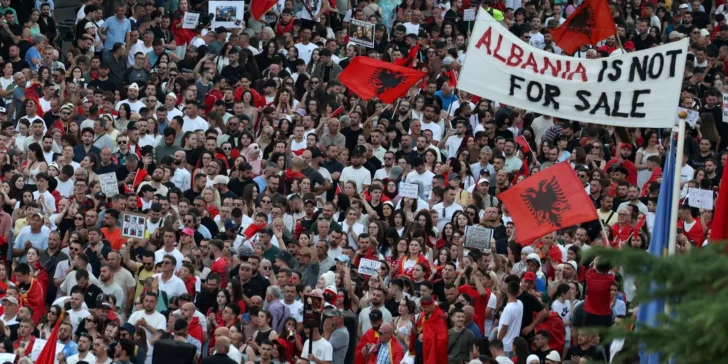
Albania, a small Balkan nation on the Adriatic coast, seldom makes headlines. But protesters waving pink flamingo cutouts on an Albanian island the Trump family wants to turn into a resort have recently attracted international media attention.
The dispute, which largely focuses on the threat the resort would pose to local wildlife, reveals more than meets the eye. Under the surface is an intricate set of problems related to Jared Kushner — President Donald Trump’s son-in-law and a close ally and confidante of Israeli Prime Minister Benjamin Netanyahu — and the presence in Albania of an Iranian exile group opposed to the current government in Tehran. All that comes on top of the news that the Albanian anti-corruption authorities have launched a probe into Kushner’s deal with Tirana, which poses a direct test also for the European Union which Albania seeks to join.
The Vjosa-Narta Delta — home to rare flamingos, pelicans, and turtle hatcheries — became Europe’s first Wild River National Park in 2023. But after Trump’s 2024 reelection, Kushner unveiled plans for a multibillion-dollar resort on the protected island. Prime Minister Edi Rama’s government granted “strategic investor status” to a Kushner-linked firm, reportedly waiving taxes and tenders and bypassing environmental reviews. When construction recently began, a “Flamingo Revolution” erupted.
What’s really important here is the possible geopolitical ramifications of this real estate project. During Trump’s first presidency, Kushner promoted the Abraham Accords – so-called normalization deals between Israel and Arab nations, including the United Arab Emirates and Bahrain. Netanyahu hailed those agreements as a great diplomatic triumph. Kushner and Netanyahu reportedly remain in close contact, even as Kushner negotiates with Iran on behalf of the Trump administration. Kushner’s investment firm, Affinity Partners, was explicitly created to deepen economic ties between Israel and the Arab world.
To understand the broader context, recall Israel’s classic “periphery strategy.” For decades, Tel Aviv has cultivated ties with non-Arab states on the edges of the Middle East — from the Caucasus to the Balkans to Africa — as a way to break its diplomatic isolation. Today, that strategy is alive and well. Israel has forged close relationships with Azerbaijan (a key energy partner and Israel’s intelligence foothold on Iran’s border), Serbia (which has significantly increased its arms imports from Tel Aviv), Romania (which announced it will move its embassy to Jerusalem), and now Albania.
Albania fits perfectly into this picture. Strategically located in the Balkans, it is a Muslim-majority but secular state, a staunchly pro-American NATO member, and an eager actor looking to prove its value to Western allies. Crucially, it is also a European Union candidate country. Having another friendly nation inside the EU — or at its doorstep — would be immensely helpful to Israel as public sentiment across Europe turns increasingly critical of Israeli policies.
With EU member states debating sanctions, the potential suspension of the EU-Israel Association Agreement, or bans on trade with the Israeli settlements in the occupied Palestinian territories, any sympathetic voice in the EU can be very helpful. Tirana is not yet a member, but its trajectory matters; and Prime Minister Rama has proved himself a strong ally.
Nowhere is Rama’s alignment with the Trump-Netanyahu tandem more visible than in his treatment of Iran. Albania is the country where thousands of members of the Mojahedin-e-Khalq (MEK), the exiled Iranian opposition group that was previously on the U.S. and EU terrorist lists, have relocated after leaving Camp Ashraf in Iraq in a deal brokered by the Obama administration in 2013.
The fact they found their new home in Tirana is mostly due to a refusal by most other nations approached by Washington to host them. The relocation was conceived as a humanitarian gesture, rather than the provision of a new operational base for the discredited group.
That arrangement was not fully respected; there is documented activity of MEK bots originating from Albania. But Rama has embraced the MEK nonetheless, using it as a cudgel against Tehran.
As the Flamingo Revolution spread, Rama publicly blamed Iran for stoking the protests. In a blistering statement addressed to the Islamic Republic, he accused Tehran of cyberterrorism, of targeting Albanian institutions, and of hostility “toward freedom itself.” He then pivoted to a full-throated defense of Albania’s decision to shelter the MEK (without naming it directly), framing its members as “Iranian men and women whom you sought to silence through intimidation, imprisonment and death.”
This is remarkable for two reasons. First, it effectively endorses the MEK as freedom fighters — exactly the language used by top officials of the first Trump administration, including former secretary of state Mike Pompeo and National Security Adviser John Bolton, who reportedly have been well compensated for their pro-MEK advocacy.
Second, it deflects entirely from the allegations of domestic corruption and environmental destruction at the heart of the protests. There is no evidence the protesters waving flamingos are Iranian agents. They are Albanian citizens worried about their coastline. But by blaming Tehran and wrapping himself in the mantle of resistance to theocracy, Rama seeks to transform a local scandal into a battle in a global proxy war — one that aligns perfectly with pro-Israel interests.
This raises the question of the extent to which Albania’s foreign policy is aligned with the EU as it seeks to join the bloc. Even as the EU relations with the Islamic Republic are arguably at their lowest point since 1979, the EU does not recognize MEK as a legitimate interlocutor; nor does it seek to endorse the group in any shape or form.
To accentuate the split with Brussels, Albania joined Trump’s so-called “Board of Peace” and even agreed to send peacekeepers to Gaza, as per Trump’s plan, endorsed by Netanyahu.
In a sign of a deeper alignment with Netanyahu’s Israel, Rama traveled to Jerusalem, spoke before the Knesset, and was praised by Netanyahu for his “moral conscience.” There, he blamed “no one else but Hamas” for the Israeli military retaliation for Hamas’ October 7 atrocities – even though that retaliation has killed over 70,000 Palestinians in Gaza in what the International Court of Justice, a U.N. rapporteur and numerous international legal experts have characterized as plausibly constituting a genocide or genocidal acts. Such alignment accrued Rama tangible benefits, such as arms deals with Israeli firms like Elbit Systems.
While this geopolitical divergence is concerning, foreign policy is still the preserve of member states and candidates to join the EU, and some EU members have strong ties with Israel anyway. However, the allegations of corruption against Rama are one dimension where Brussels can exert real leverage.
Since Albania received EU candidate status in 2014, and formal membership negotiations started in 2022, the EU has repeatedly expressed concerns over corruption and the weakness of the rule of law in Albania. When protesters ask basic questions about who benefits from a Trump-owned resort on a nature preserve, Rama not only accuses Iran of meddling but insists there is “absolutely no chance” the development will stop.
Brussels cannot afford to look away. The EU could hold the Albanian government accountable here by demanding transparency; conditioning enlargement funds on strengthening the rule of law and the fight against corruption; and, ultimately, putting the accession negotiations on hold if those conditions are not fulfilled.
What Brussels needs is political will to protect its own tattered reputation. The flamingo-wielding protesters are not Tehran’s pawns. They are citizens fed up with the political elite’s high-handed neglect and arrogance, of which the Kushner project is only the latest expression. Brussels should start listening — and acting.
*Additionally*
New Billionaire Jared Kushner Is Mired in Conflicts of Interest as “Peace Envoy”
By Derek Seidman, reposted from Truthout, June 12, 2026
“Kushner is now a billionaire,” proclaimed Forbes in September 2025 of Donald Trump’s son-in-law Jared Kushner. While just over half of Kushner’s wealth — $560 million — comes from his family’s real estate empire, what’s catapulted Kushner into billionaire status is the growth of his private equity firm, Affinity Partners, formed in 2021.
“[T]hese days,” said Forbes, Kushner is “laser-focused on Affinity.”
Kushner is not an experienced investment manager. His key clients are Gulf state sovereign wealth funds — hugely wealthy state-owned coffers that invest revenue generated by fossil fuel sales — overseen by the same regimes with whom Kushner is now involved diplomatically as a U.S. “special envoy for peace.”
That Kushner personally profits from, and is currently trying to raise billions from, the same actors he’s negotiating with, raises code red-level alarms over potential conflicts of interest. Moreover, two of Trump’s sons, Donald Jr. and Eric, have been tied to a slew of business deals connected to companies that are benefitting handsomely from federal government contracts.
“The degree of shamelessness is unprecedented,” Jeff Hauser, founder and executive director of the Revolving Door Project, a watchdog group monitoring the U.S. executive branch, told Truthout. “The degree of unity among elected Republicans to not speak about the Trump progeny, and their corruption, is the worst conspiracy of silence in American political history.”
Affinity Partners
Jared Kushner founded Affinity Partners in 2021, and he is the firm’s sole owner. Forbes estimates Affinity was worth $215 million as of September 2025, up from $170 million in October 2024. Through Affinity, Kushner recruits wealthy clients and invests their money through funds that acquire stakes in different companies.
Affinity currently has $6.2 billion in assets under management. According to the Israeli financial paper Globes, Kushner earns “a commission of 1.25 percent on investors’ capital.” Forbes says that Affinity’s investors “pay about $60 million per year in fees.”
The New York Times also reports that Affinity has earned an estimated 25 percent rate of return on its investments since 2021. Private equity investment firms often get a double-digit percentage cut on client returns.
Affinity’s biggest clients are Gulf state sovereign wealth funds. According to The New York Times, Saudi Arabia’s Public Investment Fund, which invests the kingdom’s oil profits and is led by Crown Prince Mohammed bin Salman, is “already the largest and earliest investor in Affinity,” having invested $2 billion with the firm after Trump’s first term ended. As part of that investment deal, Saudi Arabia was also given “the first chance to invest during any subsequent attempts by Affinity to raise funds,” said The New York Times.
The sovereign wealth funds of both the United Arab Emirates (UAE) and Qatar were also early investors in Affinity Partners, with the UAE investing over $200 million in Kushner’s firm.
“Most of Affinity’s investors came through connections Kushner made while serving in the White House,” wrote Forbes.
Kushner is currently trying to raise $5 billion or more in new funds for Affinity. As part of this effort, The New York Times reported in March 2026 that Affinity representatives had met with Saudi Arabia’s Public Investment Fund and that the United Arab Emirates and Qatar “are also expected to be asked for more” as the fundraising efforts should “stretch on for the better part of this year,”
“Staggering Conflicts of Interest”
Kushner’s current fundraising efforts with Gulf state regimes, through which he aims to personally profit, raise serious concerns over conflicts between his business interests with regional states and his diplomatic role as a top Trump administration negotiator.
“There’s an enormous conflict of interest when you have somebody who had never been a money manager like this before, and who is all of a sudden building massive funds based off a handful of foreign investors with an interest in buttering up the Trump administration,” said Hauser.
Hauser said it’s “not unprecedented” for well-connected family members or friends of presidents to influence U.S. diplomacy. But, he adds, “it is very susceptible to abuse, and I think it’s being abused here,” and government reforms are needed in the wake of Kushner’s current “diplomatic exploits.”
The potential conflicts of interest have been highlighted by some members of congress. Rep. Jamie Raskin (D-Maryland) has opened an investigation into what he labels Kushner’s “foreign entanglements and staggering conflicts of interest.”
“From the standpoint of the American people, your decision to act in these two roles — one public for the government and one private for personal profit — creates a glaring and incurable conflict of interest,” Raskin wrote in a letter to Kushner.
Kushner’s diplomatic efforts have included helping to design and advance the Abraham Accords, which aims to normalize relations between Israel and key Gulf States; carrying out negotiations with Iran, whose retaliatory strikes have been aimed at nations like Saudi Arabia and the UAE; and working on Donald Trump’s “Board of Peace,” which several Gulf states, including top Affinity clients, have joined.
Kushner’s Portfolio Companies
Affinity Partners’ most significant deal has been its $55 billion acquisition in 2025, in partnership with Saudi Arabia and other investors, of the video game giant Electronic Arts, maker of popular franchises like Madden and Sims. The transaction, which has garnered protests from gamers and developers, would be the largest-ever private buyout of a publicly-traded company. It’s currently in its final stages of approval.
Under the deal’s terms, Saudi Arabia’s sovereign wealth fund — which already had a 10 percent stake in Electronic Arts — will own 93.4 of EA, while Affinity Partners will own 1.1 percent. For Saudi Arabia, the deal advances two separate but intertwined aims: diversifying its economy away from overreliance on oil revenue, and partnering with a member of the Trump family as the deal seeks regulatory approval from the U.S. Committee on Foreign Investment, chaired by Trump’s Treasury Secretary Scott Bessent
Affinity Partners also invests in smaller AI and financial companies, including U.K. digital bank OakNorth, AI infrastructure firm Universal AGI, and the fintech start-up company Revolut. Forbes reports that Kushner recently launched a new San Francisco-based AI start-up with the prominent Israeli-born venture capitalist Elad Gil. The firm, Brain Co., also raised funds from Coinbase’s Brian Armstrong and LinkedIn’s Reid Hoffman.
Raising more potential for conflicts with his diplomatic role, Kushner also has stakes in several Israeli companies, including $1.68 billion in Phoenix Financial, one of Israel’s leading insurance and financial companies. Affinity is Phoenix’s top shareholder and has seen a five-times return on its investment.
Affinity is also invested in the Israeli Shlomo Group, one of Israel’s largest holding groups with big investments in the auto sector.
Kushner, TikTok, and the Trump Web
Jared Kushner is also embedded in a wide web of business figures advancing the Trump agenda — which could be seen in the January 2026 deal that created a U.S. spinoff of TikTok.
Kushner’s Electronic Arts deal is co-led by Silver Lake, a Los Angeles-based private equity firm. As Truthout previously reported, Silver Lake is also a 15 percent stakeholder in the new U.S. TikTok. The firm’s co-CEO Egon Durban sits on the seven-member board of U.S. TikTok.
In 2025, the Wall Street Journal reported that acquiring Electronic Arts was Durban’s “dream deal,” but that “the pieces began to fall into place” for the acquisition only after Durban “began spending time with Jared Kushner.”
Silver Lake also owns Endeavor, whose portfolio includes TKO Group Holdings, the parent company of Ultimate Fighting Championship (UFC), the mixed martial arts corporation that is chummy with Donald Trump.
Durban and Silver Lake are close business partners with Michael Dell, the megabillionaire chairman and CEO of Dell Technologies who is also part of the U.S. TikTok ownership group with Durban. Dell has cast himself as a Trump ally by donating $6.25 billion toward the president’s so-called “Trump Accounts” program, which creates investment accounts for U.S. children.
Billionaire Yuri Milner, another U.S. TikTok investor, previously invested $850,000 in a real estate company started by Kushner in 2015. Jon Winkelried, the billionaire CEO of TPG Global, a private equity firm represented on U.S. TikTok’s board, also previously served as a strategic adviser and partner for Thrive Capital, an investment firm overseen by Jared Kushner’s brother, Josh Kushner.
The Trump Sons
If Kushner, Donald Trump’s son-in-law, may be personally benefiting from his closeness to the president, so too might be two of the president’s own children.
Donald Trump Jr. is a partner with an investment firm called 1789 Capital, which he says is dedicated to “patriotic capitalism,” and which has seen its assets under management boom from $200 million to $3.5 billion over the past year.
1789 Capital has made investments in companies that have gone on to benefit from federal contracts. For example, the Trump administration helped secure a $620 million loan for Vulcan Elements, a rare earths firm, months after 1789 Capital acquired a stake. Other 1789 Capital portfolio companies that benefit from federal contracts include rocket propulsion start-up Firehawk Aerospace, quantum computing company PsiQuantum, and AI group Cerebras Systems, as well as SpaceX and Anduril. Donald Trump Jr. and Eric Trump have also been linked to other drone makers, including Unusual Machines and Powerus, that have secured federal contracts.
Trump Jr. told the Financial Times that he is “very involved in the strategic decisions regarding where to invest” the resources of 1789 Capital.
The Financial Times also reported that Eric Trump accompanied his father on his recent state visit to China at the same “a company linked to him and the US president’s family” — Alt5 Sigma, a Las Vegas-based financial technology company — “explores a deal” with Chinese chipmaker Nano Labs that U.S. lawmakers says is tied to the Chinese Community Party. Eric Trump is an “observer” on the board of Alt5 Sigma, while Zach Witkoff, the son of top Trump aide Steve Witkoff, chairs Alt5’s board.
The Financial Times also reports that a shell company backed by Donald Trump Jr. and Eric Trump is set to merge with a critical minerals group that last year secured up to $1.6 billion in U.S. government backing to mine tungsten in Kazakhstan. Now, that group is asking for $400 million more from the government.
Holding Politicians to Account
While Donald Trump may be struggling in the polls, his family, financially, is doing just fine.
Hauser told Truthout that much of Donald Trump’s “economic interest” is tied to “increasing the wealth of his kids,” including his son-in-law Kushner. “When they are engaged in these types of overseas actions, they are carrying Trump’s interests with them inherently,” said Hauser.
But, Hauser adds, the law treats adult children of presidents as wholly independent from their parents, allowing “relative impunity” for their intermixing of business transactions with diplomatic roles or close familial relations.
“The law is just not written to address this type of situation,” said Hauser.
But Hauser sees hope in past U.S. history, which he says has always experienced vicissitudes of political corruption and revulsion against corruption that propels reform through both legal avenues as well as social ostracization of bad actors.
“Political corruption cycles tend to be cyclical,” he said. “Hopefully this is [the] nadir, and we can all be angry enough and hold our politicians to account such that they start to clean this up, and we can switch from a vicious cycle of ever-increasing corruption to a virtuous cycle of greater integrity.”
Eldar Mamedov is a Brussels-based foreign policy expert and Non-resident Fellow at the Quincy Institute.
Derek Seidman is a writer, researcher and historian living in Buffalo, New York. He is a regular contributor for Truthout and a contributing writer for LittleSis.
RELATED:
- Larry Ellison and Jared Kushner bid to buy Warner Bros
- Why Tony Blair and Jared Kushner were at the White House to discuss Gaza
- Jared Kushner’s Firm, Backed by Gulf States, Becomes Top Shareholder in Israeli Companies Tied to UN Settlements Blacklist
- Trump pardons brokered by groups tied to Jared Kushner
- Trump pardons Jared Kushner’s father, Netanyahu friend & supporter