A new report that Israel touts as “evidentiary breakthrough” is little more than a repeat of earlier attempts to “prove” widespread rape: unsubstantiated claims, secondhand accounts, discredited witnesses, outright lies, and most importantly, a total absence of accusers.
By Ali Abunimah, reposted from Electronic Intifada, May 14, 2026
This article contains graphic descriptions of sexual violence
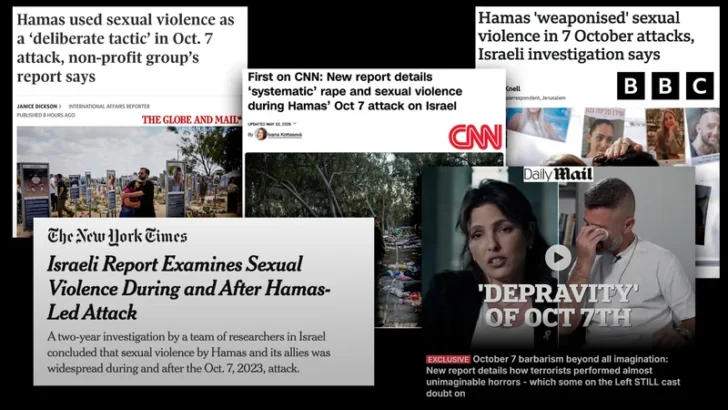
Major media outlets are promoting a new report as an evidentiary breakthrough on alleged mass rapes of Israelis by Hamas on 7 October 2023.
It is nothing of the kind. Weighing in at almost 300 pages, “Silenced no more,” published by a supposedly independent “Civil Commission,” is largely a repackaged compilation of old claims, anonymous allegations and speculation.
This includes numerous claims from figures whose accounts have already been exposed as contradictory, unreliable or fabricated.
But you wouldn’t know this from how the media are covering it.
Britain’s Daily Mail claimed that the report revealed “for the first time” the “full depravity” of the “unimaginable” sexual horrors committed by Hamas “which some on the Left STILL cast doubt on.”
CNN called the new report a “landmark” and invited its principal author for an interview.
The BBC termed it “the most comprehensive” report documenting “rapes, sexual assault and sexual torture” against Israelis.
None of these outlets offered any skepticism or cautious scrutiny – certainly not of the kind they apply when it comes to almost any account of Israeli violence against Palestinians.
Le Monde, in an otherwise sympathetic article, offered a rare hint of criticism, acknowledging that the report may be challenged for combining alleged incidents “of different natures” including acts “for which the sexual dimension is not clear.”
According to The Globe and Mail, the report purports to uncover patterns of “rape, gang rape, other forms of sexual assault, sexual torture – including burning and mutilation,” as well as claims of postmortem sexual abuse, humiliation and desecration of bodies.
Horrifying material, if true. But tellingly, the Canadian newspaper acknowledges that the report asserts that “sexual violence was both widespread and systemic, though it does not provide the number of victims.”
Discredited “Civil Commission”
Indeed, the Civil Commission – an initiative launched by Israeli legal scholar Cochav Elkayam-Levy soon after 7 October – was already severely discredited by Israeli media more than two years ago.
Elkayam-Levy came under fire for her shoddy research methods– which managed to embarrass even some in the Israeli government.
“People disconnected from her because her investigation is not accurate,” an Israeli government source told Ynet, the online outlet affiliated with Israel’s mass circulation newspaper Yedioth Ahronoth.
The government source cited how Elkayam-Levy disseminated a story about Palestinian fighters “slicing the belly of a pregnant woman – a story proven to be untrue, and she spread it in the international media.”
“It’s no joke. Little by little, professionals have begun to distance themselves from her because she is unreliable,” the source added, citing the damage such false accounts do to Israel’s already battered credibility.
It had previously been exposed that Elkayam-Levy also tried to pass off an old photo of a deceased Kurdish female fighter in another country as a victim of the 7 October violence.
Elkayam-Levy also came under fire for financial opportunism.
“She took donations from loads of people and she began asking for money for lectures,” the government source told Ynet.
But these warnings did not scare off a slew of Israel lobby funders including Combined Jewish Philanthropies, Jewish Federations of North America, the Jewish Federation of Los Angeles, the Jewish Federation of Greater Philadelphia, the Jewish United Fund of Metropolitan Chicago, the New Israel Fund and the Wilf Family Foundation.
The report’s funders include the German government, through its Tel Aviv embassy, which is significant since German leaders have openly promoted false claims about 7 October sexual violence, including the fabrication that Hamas fighters filmed themselves raping Israeli women on 7 October.
On its website, the Civil Commission separately lists “our valued partners” including Microsoft and the government of Canada.

The report’s first dozen or so pages are dominated by endorsements from such ardently pro-Israel celebrities and politicians as Hillary Clinton, Sheryl Sandberg and Rahm Emanuel.
Canadian politician Irwin Cotler is identified as a “principal contributor” and wrote a foreword. Cotler is a long-time Israel lobby stalwart and widely regarded as an apologist for Israel’s crimes against Palestinians.
Cotler is also an honorary board member of “Doctors Against Racism and Anti-Semitism,” a pro-Israel group that urged the University of Toronto to treat accusations of Israeli apartheid or genocide as anti-Semitic.
In 2024, an investigation by Canadian publication The Maple found that key claims Cotler has made for years about his relationship with Nelson Mandela and the anti-apartheid struggle in South Africa were unsupported or contradicted by South African sources.
The missing rape victims
Does the report offer anything new?
The authors claim they conducted more than 430 “formal and informal interviews, testimonies and meetings” and relied on media interviews, investigative reports, documentaries, podcasts, parliamentary hearings and an index of public reporting related to alleged sexual violence.
The key problem with Israel’s 7 October mass rapes narrative has never been merely the failure to name victims publicly. Privacy concerns could justify anonymizing survivors and withholding identifying details.
Yet to this day, Israel has not provided even the most basic anonymized accounting one would expect in a serious investigation: How many people have complained that they were raped on 7 October, how many deceased persons have been positively identified as rape victims, how many families have been informed that their relatives were assessed to have been raped, and how many alleged cases rest only on witness inferences, hearsay or speculation based on the condition of bodies observed by lay persons?
The Civil Commission report does not fill that gap. It offers no clear victim count and no transparent case list, only a mixture of old public claims, confidential archive references, secondhand accounts and generalized pattern assertions.
In January 2025, an Israeli prosecutor admitted there were still zero complainants in alleged 7 October rape cases.
This remains the basic hole in the entire narrative and the Civil Commission does its best to obscure it.
It claims that confidential information has been withheld and that findings are sometimes presented only in “generalized terms” to avoid identifying victims, including in cases where families of murdered victims may not know sexual crimes were allegedly committed against relatives.
That means some of the report’s most horrifying claims are, by design, insulated from meaningful public scrutiny.
Protecting privacy is of course a legitimate and overriding concern, but that cannot explain the glaring absence of firsthand rape victim testimonies.
There is no reason why the authors could not include anonymized first-person testimonies from rape survivors using pseudonyms and omitting details that could identify them – standard practice in human rights reporting.
The same problem appears in the kibbutzim section: The report itself states that there are “no known survivors of [sexual and gender-based violence] from any of the kibbutzim attacks on October 7th,” other than those taken into captivity.
Publishing anonymized first-person testimonies is precisely the approach researchers took when publishing the explicit and detailed firsthand accounts of Palestinian survivors of rape and sexual torture in Israeli military detention.
Indeed the Civil Commission report includes a number of anonymized testimonies of alleged acts of sexual violence other than rape. But there are no firsthand victim testimonies of rape – except for one, a male identified as “D,” an Israeli intelligence veteran who claims he was the victim of a gang rape.
D’s claims were previously reported in Israeli media in July 2024 – where he was identified by the Hebrew letter “Dalet” – after he filed a lawsuit demanding roughly $137 million from the Israeli government.
The Civil Commission claims that D’s account is “supported by” medical records.
But Amnesty International also previously interviewed D and reviewed his medical records. Its account suggests there is much less substance than the Civil Commission would like people to think.
According to Amnesty: “The reports show that he visited the doctor twice, in March and May 2024, that he reported during both visits anxiety and fears from having been at the Nova festival when it was attacked and that he reported, during the second visit, having been subjected to sexual assault at the Nova festival site.”
Such records may be evidence that D told a doctor in May 2024 that he had been raped the previous October. But from Amnesty’s careful description there does not appear to be any medical evidence of the attack itself.
No firsthand accounts of rape in captivity
The Civil Commission report asserts that Israeli men and women who returned from captivity in Gaza have “testified to experiencing rape, sexual torture and other forms of sexual abuse during their abductions and/or in captivity, as well as to witnessing sexual acts inflicted upon other hostages, including family members.”
However the captivity section does not appear to include a direct, first-person account from a returned hostage stating that she or he was raped in captivity.
The only specific public source the report cites for rape of captives appears to be a June 2024 Washington Post interview with former captive Moran Stella Yanai who explicitly states of her captors, “They didn’t rape me, they didn’t touch me.”
But the Post adds: “What haunts her most are the firsthand accounts of rape from other female hostages, whispered to her in captivity. She holds their secrets, not divulging names to protect their privacy, and to not further endanger their lives.”
It is notable that many of the former captives’ testimonies describe fear of rape, threats, humiliation, forced nudity or other alleged sexual abuse, but none provides a direct, firsthand victim account of rape.
The report does contain a few new allegations of sexual assault against former captives, including a claim that two minors “who were family members, reported that they were forced to perform ‘sexual acts on one another’ ” while in captivity in Gaza. Little additional information is provided.
Such accounts, said to have been given directly to the Civil Commission, cannot be independently assessed from the report’s public text, and come from an organization with a track record of dishonesty and of relying on discredited sources.
But even if they are true, they do not support the main pillar of Israel’s narrative of mass rapes and gang rapes on 7 October.
Thousands of photos and videos, but none of any rapes
Just as striking is the commission’s evasiveness about the visual evidence it claims to have reviewed.
“Across all sites of the attacks reviewed by the Commission, perpetrators were observed celebrating the massacres, chanting religious slogans, and filming scenes of violence and humiliation,” the report claims.
The report also asserts that on 7 October, Israelis “were hunted, executed, tortured, burned alive, mutilated, sexually violated and taken hostage in acts of extreme brutality.”
The Palestinians who allegedly carried out these acts, the report claims, “filmed and broadcast them in real time, transforming their violence into spectacle and human suffering into an instrument of terror.”
And in an age where almost everyone is carrying a camera, thousands of Israeli witnesses would have had the opportunity to take photos and videos as well.
Indeed, the authors boast of analyzing more than 10,000 photographs and video segments, totaling more than 1,800 hours, but the report never says that any of those materials depict an actual rape or gang rape in progress.
The only detailed description of body camera footage allegedly filmed by a Palestinian fighter on 7 October and seen by the Civil Commission appears to be of the killing of several female Israeli soldiers at a military base. The Civil Commission does not describe this video as depicting rape or any other sexual violence.
The absence of visual evidence of even a single rape is glaring considering the scope of the Civil Commission’s claims.
But it is consistent with the March 2024 report by UN special representative Pramila Patten.
The UN team headed by Patten also reviewed thousands of photos and videos provided by the Israeli government and concluded that “in the medicolegal assessment of available photos and videos, no tangible indications of rape could be identified.”
Despite extensive searches, “no digital evidence specifically depicting acts of sexual violence was found in open sources,” the UN report added.
Moreover, in April 2024, the Israeli newspaper Haaretz reported that “the intelligence material collected by the police and the intelligence bodies, including footage from terrorists’ body cameras, does not contain visual documentation of any acts of rape themselves.”
Nothing in the Civil Commission report challenges these findings, but to disguise the stark lack of visual evidence to support the rape narrative, the report invokes the authority of thousands of photos and videos while carefully avoiding any assertion that any image or video actually shows such an attack taking place.
Recycled and discredited accounts
The report’s individual 7 October alleged cases are almost entirely familiar. It leans again on a cluster of “eyewitnesses” – not firsthand victims – whose accounts lack credibility or corroboration, have changed over time or have been debunked outright.
This includes a woman called “Sapir” – who supposedly witnessed women being gang-raped and mutilated, and also claimed to have seen Palestinian fighters carrying severed heads.
This fantastical account, for which no corresponding victims, bodies or forensic evidence have ever been publicly produced or independently verified, was featured in the notorious and discredited December 2023 New York Times article “Screams without words.”
As the Times claimed, Sapir saw Hamas fighters raping several women and then she witnessed “terrorists carrying the severed heads of three more women.”
Sapir’s story was also featured in Screams Before Silence, billionaire former Facebook executive Sheryl Sandberg’s 2024 film pushing the mass-rapes hoax – debunked in detail by The Electronic Intifada after its release – but in the film there is no mention of the severed heads Sapir supposedly saw.
The Civil Commission report includes Sapir’s testimony while omitting the even more sensational claim about beheaded women that had appeared in the Times account.
While leaving out this shocking element from Sapir’s testimony, the Civil Commission report nonetheless repeatedly cites the discredited New York Times article bylined by Jeffrey Gettleman, Anat Schwartz and Adam Sella as if it were a credible source.
About a hundred pages later, separately from Sapir’s firsthand testimony, the report asserts that witnesses claimed to see “perpetrators carrying the severed heads of women.” A footnote attributes this claim to Sapir. If the Civil Commission considers it credible – despite the lack of corroboration – why omit it from Sapir’s own testimony?
The report also includes other dubious “eyewitnesses” such as Raz Cohen and Tali Biner.
Cohen – whose story has changed repeatedly – is featured in the Gettleman article and both he and Biner appear in the Sandberg film.
Fabulists, liars and grifters
These are not even the most egregious examples.
The Civil Commission report cites a number of other individuals whose credibility has collapsed, including Rami Davidian, prominently featured in the Sandberg film claiming to have single-handedly rescued hundreds of Israelis from the clutches of Palestinian fighters on 7 October.
He also claimed to have seen dozens of dead victims of alleged rapes on that day, some with objects inserted into their genitals, but told Sandberg that he altered the positions of the bodies so that – conveniently enough – no one else would ever see what he saw.
In May 2024, The Electronic Intifada pointed to the glaring inconsistencies and impossibilities in Davidian’s claims.
A year later, an investigation by Israel’s Channel 13 found that Davidian had indeed fabricated his tales of superhero-like heroism and used his fame to enrich himself with huge speaking fees and donations.
“These are not slight exaggerations, mildly inflating the number of those rescued, absolutely not,” Channel 13 journalist Raviv Drucker stated. “These are stories made up from beginning to end. Hair-raising stories that never, ever occurred.”
And yet Davidian is cited extensively as a source in the Civil Commission report.
Similarly, the report relies extensively on claims from members of ZAKA, the Israeli “rescue” organization responsible for notorious 7 October lies such as the false claims of dozens of beheaded babies and burned children.
The group played a prominent role in lending “first responder” credibility to such atrocity propaganda, helping generate public consent for Israel’s genocide in Gaza after 7 October.
ZAKA was founded by Yehuda Meshi-Zahav, who died by suicide after being exposed in Israel as a serial sexual predator accused of violent sex crimes against Jewish men, women and children over decades.
After Meshi-Zahav’s victims spoke out, ZAKA’s Chaim Otmazgin publicly defended him, claiming the extensive evidence against him had been acquired via extortion.
ZAKA and Otmazgin are cited repeatedly as credible sources in the Civil Commission report.
Otmazgin and ZAKA colleague Simcha Greinman also appeared in the Sandberg film making lurid and inconsistent claims about seeing nails and other objects in genital areas.
The crossover is no coincidence. The Civil Commission report explicitly thanks Kastina Communications, the producer of Screams Before Silence, for allowing it to use “materials and testimonies” collected for the film.
Painting a lurid picture
The report acknowledges in a footnote that Israeli authorities “largely did not collect relevant forensic evidence from the attack sites or the recovered bodies.”
The lack of forensic evidence is therefore another major narrative problem the Civil Commission has to contend with in addition to the lack of rape victims.
The report attempts to explain away this absence with the well-worn assertion that “Hamas operatives and collaborators methodically destroyed important evidence by setting fire to bodies, property and houses.”
Basic forensic science makes clear that destroying forensic and DNA evidence, even by fire, is not necessarily straightforward at a single crime scene.
The claim becomes far less plausible when applied to an alleged pattern of mass rapes supposedly carried out across a vast geography amid the chaos of 7 October.
The report does not address evidence that significant numbers of Israelis were killed, and many bodies incinerated, by Israeli fire during the widescale application of the Hannibal Directive, a protocol that allows the Israeli military to use overwhelming force to stop Israelis being taken captive even if that means killing them along with their captors.
But the Civil Commission – similar to the Sandberg film – does rely on multiple eyewitness accounts of bodies, for example with their legs spread or injuries to the groin area, to suggest that these persons were victims of rapes and other forms of sexual violence.
This phenomenon was already addressed in the UN’s March 2024 Patten report, which pointed to “erroneous interpretations of the state of bodies by some volunteer first responders without relevant qualifications and expertise.”
This included “mistaking ‘postmortem pugilistic posturing’ (a ‘boxer-like’ body posture with flexed elbows, clenched fists, spread legs, and flexed knees) due to burn damage as indicative of sexual violence; misinterpreting anal dilatation due to postmortem changes as indicative of anal penetration; and mischaracterizing grazing gunshot wounds to genitalia as targeted genital mutilation using knives.”
The Civil Commission report relies repeatedly on claims about the condition of bodies from first responders who were not forensic experts, including Shari Mendes, an Israeli military reservist who was at the Shura military base as it was being used as a makeshift morgue on 7 October.
Mendes appears in the 2024 Sandberg film recounting her horrifying claims about bloody underwear, naked bodies and systematic sexual mutilation.
Her claims are contradicted not only by the Patten report but also by the findings of Israeli pathologists.
As Haaretz reported in April 2024: “At Shura Base, to which most of the bodies were taken for purposes of identification, there were five forensic pathologists at work. In that capacity, they also examined bodies that arrived completely or partially naked in order to examine the possibility of rape. According to a source knowledgeable about the details, there were no signs on any of those bodies attesting to sexual relations having taken place or of mutilation of genitalia.”
The bottom line is that the Civil Commission report is the latest attempt to revive Israel’s mass-rapes hoax at a moment when Israel is despised and isolated around the world for its genocide in Gaza. The narrative invokes well-worn racist and colonial tropes of native savages raping white settler women.
But a “comprehensive” report that recycles discredited sources, cites debunked media coverage as evidence, fails to quantify the number of victims and still cannot confirm the existence of any specific rape victim, living or dead, does not rescue Israel’s mass-rape hoax. It confirms its bankruptcy.
Ali Hasan Abunimah is a Palestinian-American journalist who advocates a one-state solution to the Israeli–Palestinian conflict. A resident of Chicago who contributes regularly to publications such as the Chicago Tribune and the Los Angeles Times, he has served as the vice-president on the board of directors of the Arab American Action Network, is a fellow at the Palestine Center, and is the executive director and a co-founder of The Electronic Intifada website
RELATED:
- The Vach brothers: creators of October 7 lies, and Israel’s first family of genocide
- The Truth About Gaza’s Death Toll – Part 2: A Gross Undercount
- Collusion and insider trading: Who profited off 7 October?
- Latest Israeli report on Oct 7 sexual violence fails to make a case
- Zionist-on-Zionist war crimes
- Hannibal Directive: Israeli troops ‘killed civilian during Hamas attack and covered it up’