Many Palestinian health workers ‘suffer from hunger, dizziness, and fainting episodes while performing operations and triaging patients,’ reads an open letter signed by the healthcare professionals.
More than 100 international doctors and other healthcare professionals who have served in Gaza over the past 22 months have signed an open letter calling for global attention to the destructive Israeli assault on Palestinian healthcare workers and urging immediate international action to protect them and to restore Gaza’s decimated health system.
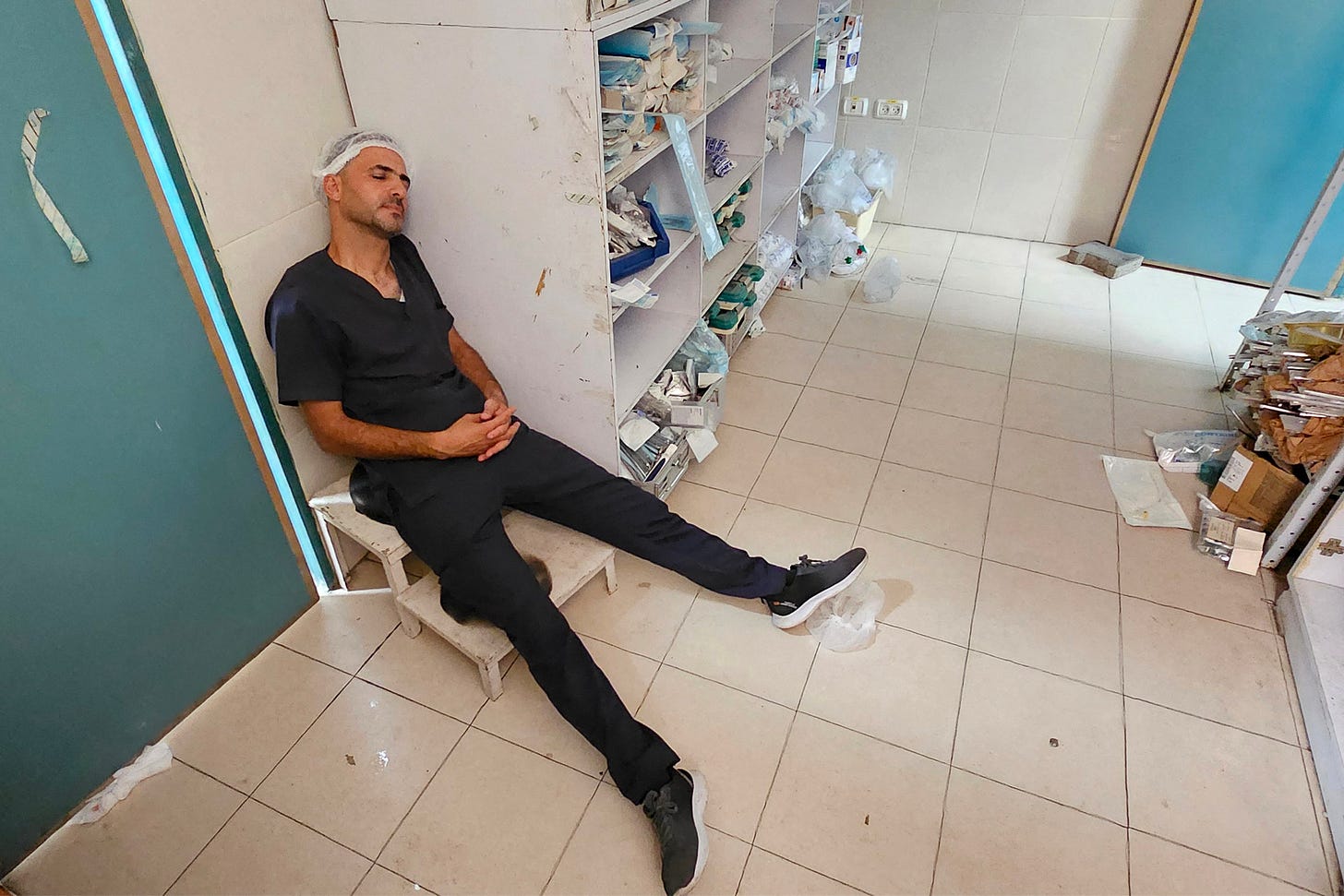
“We refuse to be silent while our colleagues are starved and shot by Israel,” the letter, shared first with Zeteo, reads. “Our Palestinian colleagues – doctors, nurses, and first responders – are all rapidly losing weight due to forced starvation at the hands of the Israeli government. Many suffer from hunger, dizziness, and fainting episodes while performing operations and triaging patients in emergency rooms.”
Those who signed the letter include Drs. Thaer Ahmad, Yasser Khan, Tanya Haj-Hassan, Ambereen Sleemi, and Nick Maynard.
Conditions in Gaza have reached the worst they’ve been in the past 22 months. Starvation deaths are accelerating at an alarming rate. Remaining hospitals still operating are at “near-total collapse” as they face an average of eight “mass casualty incidents” every day. Hundreds of thousands grow thirstier as fresh water access dwindles and disease spreads.
To make matters worse, the conditions are impacting those tasked with helping alleviate the pain. As of May 2025, the letter states, Israeli forces have killed more than 1,500 Palestinian health workers. Many more, the letter notes, have been abducted, unlawfully detained, and tortured in Israeli custody.
All the while, the letter adds, the Israeli military has severely restricted the work of international aid and medical organizations in Gaza, and blocked the “entry of critical supplies – medications, surgical tools, food, and even baby formula.” Palestinian medical professionals, who’ve also been displaced from their homes, often living in tents or makeshift shelters, have continued to serve thousands of their neighbors who are in similar situations.
In the letter, the doctors lay out exactly why the conditions in Gaza are so bad.
“Patients cannot heal without adequate nutrition and access to comprehensive health services. If someone survives being shot by an Israeli soldier or a blast injury from an Israeli warplane, they still have to heal from their wounds. Malnutrition is a major barrier to full recovery, leaving people susceptible to infections for which very little treatment is now available in Gaza,” reads the letter.
“Put simply: Your body cannot heal when you have not eaten properly in days or sometimes weeks, as is now commonplace in Gaza. The same is true for doctors and healthcare workers, who are struggling to provide care while facing the same conditions of extreme deprivation.”
More than 100 medical professionals were joined by more than 150 allied healthcare workers, who also signed the letter.
“We sign this letter in solidarity – and in outrage. We reject the violence of silence and supposed neutrality while our colleagues are starved and shot at by Israel.”
Read the full letter below:
The Doctors’ Letter – Voices in Solidarity with our Palestinian Colleagues in Gaza
We refuse to be silent while our colleagues are starved and shot by Israel.
We, the undersigned healthcare professionals, have worked alongside our Palestinian colleagues in Gaza since late 2023, and have witnessed firsthand the scale and severity of suffering.
Today, we raise our voices again in full solidarity with our Palestinian colleagues in Gaza, all of whom continue to endure unimaginable violence.
Israel’s ongoing genocide and deepening siege have effectively destroyed the entire health system in Gaza. The few remaining partially functioning hospitals are held together by the determination and commitment of Palestinian doctors and nurses, all of whom continue to care for patients despite the constant risk of targeting, and now starvation too.
Our Palestinian colleagues – doctors, nurses, and first responders – are all rapidly losing weight due to forced starvation at the hands of the Israeli government. Many suffer from hunger, dizziness, and fainting episodes while performing operations and triaging patients in emergency rooms. Most have been displaced into tents after being forced from their homes, and many are surviving on less than a single serving of rice a day.
The humanitarian consequences of the political crisis in Gaza are not only marked by Israel’s direct military onslaught against the entire population, but also by Israel’s methodical attack on the health system:
-
Palestinian healthcare workers have been killed in large numbers as a result of Israel’s repeated and systemic attacks on the health system and health workforce. Over 1,580 health workers had been killed as of May 2025.
-
The Israeli military has abducted, unlawfully detained, abused, and tortured hundreds of Palestinian healthcare workers, holding them in abject conditions in prisons and detention camps.
-
The Israeli state has repeatedly blocked patient evacuations and international medical initiatives, and has closed or obstructed critical evacuation and humanitarian routes.
-
Israel continues to systematically block the entry of critical supplies—medications, surgical tools, food, and even baby formula. As a result, Palestinian health workers must try to save lives in hospitals without the most basic supplies that are readily available only a short distance away.
Patients cannot heal without adequate nutrition and access to comprehensive health services. If someone survives being shot by an Israeli soldier or a blast injury from an Israeli warplane, they still have to heal from their wounds. Malnutrition is a major barrier to full recovery, leaving people susceptible to infections for which very little treatment is now available in Gaza.
Put simply: Your body cannot heal when you have not eaten properly in days or sometimes weeks, as is now commonplace in Gaza. The same is true for doctors and healthcare workers, who are struggling to provide care while facing the same conditions of extreme deprivation.
These are not logistical challenges that can be solved simply by more medical aid or more international medical delegations. This is an entirely man-made crisis driven by limitless cruelty and complete disregard for Palestinian life.
We demand immediate international action to:
-
Protect Palestinian healthcare workers and all Palestinians, including coordinated efforts to secure the immediate release of unlawfully detained Palestinians and Palestinian health workers.
-
Protect health sites and immediately stop the attacks on all health facilities, including hospitals, health clinics, and ambulances, as mandated by international law.
-
Lift Israel’s illegal blockade and ensure unimpeded humanitarian access for food, clean water, medical supplies, and fuel distribution; and ensure unobstructed access for international medical delegations throughout Gaza.
-
Ensure an immediate and permanent ceasefire, and an end to the unlawful military occupation of Gaza.
-
Hold accountable those responsible for attacks, detentions, and abuse affecting the medical mission in Gaza.
We sign this letter in solidarity — and in outrage. We reject the violence of silence and supposed neutrality while our colleagues are starved and shot at by Israel.
Signed by health professionals who have worked in Gaza:
-
Mahmooda Syed, DO, MBA, FACEP
-
Brennan Bollman MD, MPH
-
Ayesha Khan, MD, MPH
-
Zahed Rahman RN, Critical Care
-
Abeerah Muhammad MSN, RN, CENEN
-
Owais Nadeem, MD
-
Sarah Badran, MD, MACM
-
Lana Abugharbieh BSN, RN, CEN
-
Nour Sharaf, DO
-
Aziz Rahman, MD
-
Talal Ali Khan, MD, FACP, FASN, FRCP
-
Elidalis Burgos, MSN, APRN, AGACNP-BC
-
James Smith, MBBS, MA, MSc, MSc, British Emergency Physician
-
Mohammad Rizwan Minhas, MD
-
Khawaja Ikram, DO
-
Noor Amin, MD
-
Arham Ali, MD, MS. Assistant Professor, Pediatric Critical Care
-
Yipeng Ge, MD, MPH, CCFP
-
Margaret Ogden, MPH, Registered Nurse
-
Qutaiba Mohammad Allawwama, Emergency Nurse
-
Sarah Lalonde, Bsc. MD, CCFP-EM
-
Zena Saleh, MD, General Surgery Resident
-
Tarek Meguid, MD,OB/GYN
-
Anas Alkassem, MD
-
Ali Khader, MD, MPH
-
Nada Al Hadithy, FRCS, MD, FMLM, PgDip
-
Mumen Diraneyya, Consultant general surgeon
-
Hamza AbdulQader, Critical Care RN
-
Thaer Ahmad, MD and board member of PAMA
-
Mir S Ali, MD, Pediatrician
-
Uzer Khan, MD
-
Feroze Sidhwa, MD, MPH, FACS, FICS
-
Deirdre Nunan, MD, FRCSC (orthopaedics)
-
Ben Thomson, MD, MPH, MSc, FRCPC
-
Ambereen Sleemi, MD, MPH Urogynecologist/ Ob Gyn
-
Ahmed Hassabelnaby, DO – Emergency Medicine
-
Saira Hussain, MBBS FRCA MA FANZCA
-
Bushra Othman, BMBS, FRACS, General Surgeon
-
Mina Naguib, Emergency Physician, BSc, BMBS, DMCC, MPH, FRCRM
-
Tom Potokar, Prof, OBE, Plastic Surgeon
-
Goher Rahbour, BMedSci, MBChB, MRCS, MD Res, FRCS
-
Nick Maynard, MD
-
Junaid Sultan, Consultant vascular surgeon
-
Aarianna Read, Registered nurse
-
Aalisha Mariam Karimi, MB BChir, MRCP, FRCA, DipHTM
-
Aqsa Durrani, MD, MPH
-
Janet Hall, Medical Doctor
-
Matthew Arnaouti, Trauma & Orthopedic Registrar
-
Kirsty Blacka, Charge Sister – Registered Nurse
-
Adam Hamawy, MD FACS
-
Ana Jeelani, Consultant Paediatric Orthopaedic Surgeon
-
Kaji Sritharan, Consultant Vascular Surgeon
-
Haleh Sheikholeslami, MD, FAAFP
-
Dr Paul Ransom, UK Emergency Physician
-
Yasser Khan, MD, FRCSC
-
Einar Lande, Gynecologist
-
Lucy Hooton, Head Nurse
-
Line Dahlgaard Berntzen, Doctor
-
John Kahler,MD, FAAP
-
Chandra Hassan, MD
-
Yassar Arain, MD
-
Nahreen Ahmed, MD MPH
-
Tanya Haj-Hassan, BMBCh
-
Mahmoud Sabha, MD
-
Khaled Al-hreish, MD
-
Nabeel Rana, MD
-
Alia Kattan, MD
-
Rana Mahmoud, RNBSN
-
Mohamad Abdelfattah, MD
-
Hina Syed , M.D.
-
Jennifer Arriaga, BSN, RN, CCRN
-
Morgan McMonagle, MB BCh FRCSI FACS MD
-
Christos Georgalas, Professor of head and neck surgery
-
Tammy Abughnaim, MD, Emergency Medicine
-
Abdullah Salameh, General surgery
-
Mohammed Akuji, Consultant Anaesthetist
-
Amy Neilson, MBBS BSc MPH&TM FACRRM FACTM FEWM
-
Jason O’Connor, Registered Nurse, PANZMA
-
Osama H. M. Hamed, Consultant Surgeon
-
Dr. Farah Abdul Aziz, MBBS FRACS
-
Montaha Khan, ICU Specialist
-
Salih El Saddy, MD, PANZMA
-
Jacklyne Scarbolo, Medical team leader, MPH
-
Jamal Merei, General surgeon
-
Patrick Ennis, NHS Advanced Paramedic
-
Husam Basheer, Orthopedic consultant
-
Mohammed Alkandari, MD
-
Ghassan Alami, MD-CM, FRCS(C)
-
Travis Melin, D.O
-
Jeremy Hickey, Specialist Anaesthetist FANZCA
-
Asma Lina fazlanie, MbChB, FRCA, MRCP
-
Mohammed Mustafa, MD
-
Sakib Rokadiya
-
Hanadi Katerji, RN
-
Victoria Rose, Consultant Plastic Surgeon
-
Martina Marchiò, PMR
-
Wilhelmi Massay, Critical Care ICU / Emergency Department RN
-
Tas Qureshi, Surgeon
-
Heba Al-Nashef, Registered Midwife, MSc.
-
Mark Brauner, DO, FACEP
-
Azeem Elahi, MD
-
Wajid Jawaid, Consultant Paediatric Surgeon
-
Michail Liontiris, MD, MScIH – Emergency Medicine
-
Haseeb Khawaja MD
-
Mohamed S A Elfar, MD, MSc, FACS, FCCM
-
Greg Shay, MD
-
Elen O’Donnell, MBBS, FACRRM, DipPH
-
Mohamed Kuziez , MD, FAAP
-
Adil Husain, M.D.
-
Mohammed Sbeih, MD, FACS
-
Chandra Hassan, MD, FACS
-
Raul Incertis Jarillo, Anesthesiologist / ER
-
Shehzad Batliwala, DO
-
Anas Ahmed, MD
-
Mark Perlmutter MD
-
Joelle Tischhauser
-
Dr Chris Holden
-
Amanda Prezioso, Nurse
-
Yacine Haffaf, Surgeon
-
Arham Ali, MD, MS. Assistant Professor; Pediatric Critical Care
-
Hamza AbdulQader, Critical Care RN
-
Rana Mahmoud, RNBSN
-
Riad Abdelkarim, MD, MHCM, FACP; Chief Medical Officer
The letter was also signed by 159 allied healthcare professionals.
Prem Thakker is a Zeteo Political Correspondent & Columnist.
RELATED:
- Israel Blocks Critical Medical Equipment From Entering Gaza Strip, Citing Potential Hamas Use
- Aid Groups: Infants Are Dying in Gaza Because Israel Impedes Import of Baby Formula
- Israel Besieges 2.3 Million Palestinians in Less Than 15% of Gaza, Amid Escalating Starvation and Mass Killings
- The infants who died at the sound of bombs: Death without weeping
- Israeli Human Rights Group Says Israel Is Committing Genocide. Why Did It Take 22 Months?