Israel has killed over 800 teachers and staff, along with 15,000 school-aged kids. Schools are in ruins.
By Hend Salama Abo Helow, Reposted from Truthout, September 13, 2025
To live in Gaza means nothing is guaranteed — neither your wealth, your buildings, your career, nor even your legacy. Only your mind and its principles endure. Growing up in a war-battered reality compelled us to cling to education, just as my father, a retired mathematics teacher, always told me: “I have not invested in entrepreneurs, but in one lasting, fruitful, and ever-present project — your education.”
This is not only my father’s mindset, but that of many in Gaza — people who, after enduring decades of repeated atrocities, have come to understand that education is neither a privilege nor a luxury, but a necessity to confront the colonial apartheid regime that tirelessly seeks to erase our very existence. Despite all the odds — complete blockade, arbitrary occupation, destitution, and relentless wars — Gaza has proven to the world that we are no less than anyone else. We, too, are educators, students, scholars, readers, and writers, with literacy rates reaching 98 percent, school enrollment at 90 percent, and higher education enrollment at 45 percent.
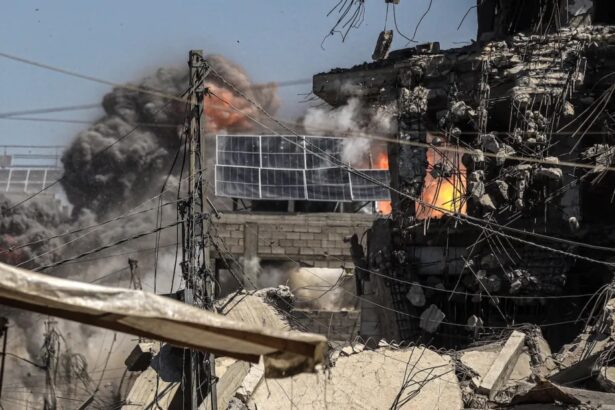
Yet the ongoing genocide has left nothing intact — not even what is supposed to be protected under international law: schools, hospitals, and residential buildings. Instead, Israel grossly and systematically targets such buildings. According to Gaza’s Government Media Office, 1,160 educational facilities — including 927 schools, universities, kindergartens, and academic centers — have been either destroyed or damaged since October 2023. More than 880 teachers and staff have been ruthlessly killed. At least 15,000 school-aged children have had their lives cut short, robbed of the chance to live, learn, or play, while 600,000 others are forced to grow up far too early, deprived of their basic right to education, and buried beneath the constant weight of fear, relentless bombardments, loss, and forced displacement.
Many of these kids have become categorized as “wounded child, no surviving family (WCNSF).” Others have become their families’ primary providers, lining up under the scorching sun for food, yet most of the time they return empty-handed. Many children have gambled with death for small parcels of food from the Gaza Humanitarian Foundation — and some lost their lives doing so.
These very students have already missed the last two school years and are now on the verge of missing a third. Instead of welcoming another year with passion, marking their excellence and expanding their knowledge, they are forced to endure a life that brutally steals their innocence. Instead of preparing new clothes or buying colorful school supplies, they are packing their belongings to flee after Israeli forces issued evacuation orders for northern Gaza, ahead of the complete invasion. Their schools have been turned into shelters — drenched in blood, their walls carved with cries of loss — instead of remaining emblems of knowledge and education.
Students’ freshly printed books have become fuel for fire, burned for survival during the devastating famine. I have myself been forced to burn a textbook to kindle a fire in order to cook a meal to ward off starvation. They have experienced loss many times over — they lost classmates in horrific airstrikes, mourned their teachers, and watched their futures collapse into ashes while they stood by helplessly.
One day at the market, I stopped at a stall run by a boy of barely 11, the same age as my nephew Ahmad. I asked him curiously: “Do you miss school? Do you self-study during these difficult times? Are you following the recently emerged initiatives to resume education online?” He looked embarrassed and quietly replied: “No. I’m not thinking about school at all. There are other responsibilities, far more important, that I must fulfill since my father’s death.”
Nearly two years into the apocalyptic genocide, education has become a distant memory. Yet initiatives continue to emerge — UNRWA-led programs; government-run virtual schools; and small, community-led efforts in areas with little to no internet access. Many students have shown interest, but countless others cannot commit under such dire conditions. My nephew Ahmad is among the disciplined, no matter how hard it is.
I often, half-ironically, comment on his commitment to study: “An apocalypse started here in Gaza while you were studying. We’re not sure if we’re going to make it, Ahmad. Try to survive — don’t juggle your studies.” My mother, Halima Al-Na’ami, an esteemed retired Arabic teacher, always replies firmly: “Education is the weapon of the defenseless. It is the only remaining way to reflect our deepest connection to this land and its legacy. By education we resist, and by education we will be liberated.”
Ahmed’s e-learning journey has been arduous and precarious, from struggling to secure a stable internet connection to carrying the fears of a child witnessing the 21st-century Holocaust. Yet he stood firm, never giving up. During one of his online classes, I overheard the teacher stumble over a student’s name. He called it repeatedly before asking: “Is Mohamed here?” No one answered. Then, in a breaking voice, a mother replied: “Mohamed was killed yesterday, and he will no longer attend this class.”
It was heartbreaking; a cruel reality. Each day, the virtual classroom lost another student. My 7-year-old nephew Bader, like hundreds of thousands of children in Gaza, has not even had the chance to know what school life truly feels like. Just days after his first school year began, the genocide erupted. He lost his best friend, Ahmed, and then his own home. I remember during one online math session, a girl suddenly asked the teacher: “Do you have food?” Another student followed: “Is there a war where you are?” My nephew, innocently, asked: “Teacher, is there ice cream in your city?” The teacher went silent, overwhelmed, and broke down in tears.

Yet Lamia Hatem Othman, an English journalism graduate and English teacher, could not leave those vulnerable children to suffer in limbo. She held a makeshift tent to teach English — a small, safe space filled with singing, drawing, and playing. Parents were astonished at the transformation in their children: from those who no longer wanted to live, to those who eagerly counted down the hours until her class.
“My students came from the south, and many were displaced from the north,” she told me. “I decided to share my diaries with them online.”
“I only focus on the bright side. I don’t romanticize or sugarcoat, but I desperately try to lift them out of the genocide’s shadow, where horror is their constant companion,” she said.
Othman shared one story that still chills her. A student named Raja walked long distances to attend her lessons. Fishing was his only escape, despite Israel’s severe restrictions on the sea. Each time, he returned with one or two fish, which he proudly shared with classmates. One day, he told her, “The next fish will be for you, Mrs. Lamia.”
But Raja never came back. Later, Othman found his name among those who were killed. His sister confirmed, in a broken voice: “He loved you a lot. The fish he caught for you is still here, in a decorated plastic bag.” Othman could not continue teaching for days after his death.
Despite this, she told me, “I’m blessed and grateful for the chance to teach these pure souls. Children even forgot how to hold a pencil or recite the alphabet, so I began again from scratch. If there is consistent education, there will always be progress.” When I asked for their messages to the world, Othman’s students were simple and raw: “We want the carnage to end at any cost.”
Ibrahim Farajallah, one of Othman’s diligent students, said, “I desperately wish to live in a real home, not in a worn-out tent, to rest my back against concrete rather than flimsy cloth.”
Ibrahim al-Bahnasawi, another student of Othman’s, dreamt of meeting his father again, who was killed on his way to bring them food.
A student named Abood pleaded for a mango, while a student named Binan said she only wanted to eat a piece of chicken.
“I was not the only one teaching — they taught me too,” Othman smiled softly as she reflected. “I learned to be patient, to live in the moment without fear. Education in genocide is not just curriculum — it is care, love, memory, and defiance. A smirk on their faces, a spark of satisfaction in their eyes — that alone is enough to overcome any problem.”

But the situation is even more dire for Tawjihi students (students preparing for the final high school examinations required for university admissions). Marah Mohamed El Khatib, 19, should have been a university sophomore by now. Instead, she has been stuck in Tawjihi for two consecutive years, with a third looming. “Imagine being trapped in the same academic year amid genocide,” she said. “Each time you prepare for exams, another roadblock appears — escalations, forced displacement. Even if you try, it could cost you your life.”
She added, “My responsibilities have changed. I was supposed to be preparing for university. Instead, I am surviving genocide. My priorities are no longer Tawjihi exams but daily responsibilities — like kneading the dough because my mother cannot, or burying, again and again, the fear of displacement.”
Despite everything, El Khatib has tried to turn her suffering into something meaningful. She began writing poems and articles.

Recently, the Palestinian Ministry of Higher Education announced a new plan for students to sit exams online beginning September 6. But El Khatib’s voice carried no relief. “The phase that should have ended in celebration has been reduced to this — I just want to finish the year, no matter the consequences,” she said. “My plight is nothing compared to others. Some of my colleagues burned their Tawjihi books to survive. My friend, Mayar Judah, was killed before she had the chance to celebrate her Tawjihi milestone.”
The conditions for students in university are no better. We are obligated to continue and pursue our studies, even when survival itself is uncertain. I myself sat for the cardiovascular module exam after a night when I thought I would not make it through at all. The weight of genocide presses into every classroom, every page, every test, turning even the pursuit of knowledge into an act of endurance.

Teachers and professors are suffering too.
“As the school year advances, all that crosses my mind is how education has been distorted,” said Munira El-Najar, a high school teacher and mother who has also been asked to do administrative work as schools have been turned into shelters.
“Schools are no longer bastions of knowledge, but shelters — or even piles of ruins,” El-Najar told me. “I keep wondering: How can a student’s memory ever heal enough to return to the same classroom where a massacre slaughtered his family?”
El-Najar explained that genocide has turned every aspect of her life upside down. “I no longer see education as a choice — it is an act of resistance. As we step into a third academic year without schools, my feelings are mixed between exhaustion and determination. Exhaustion, because the educational gap is deepening. Determination, because we have no choice but to keep going,” she said. “It is too deep to be resolved by teachers and students alone. It requires systemic effort, and above all, a safe educational environment.”
As a mother, she carries a dual burden. “I try to balance my children’s survival with their pursuit of knowledge. In genocide, education is like a candle, we do our best not to let it be extinguished,” she said.

According to UNRWA, children’s education in Gaza has been set back nearly five years, putting them at risk of becoming a lost generation. A recent UN report also warned that Gaza’s children are facing a third consecutive year without school amid Israel’s war. UN spokesperson Stéphane Dujarric stressed: “Education is a fundamental right, and no child should be denied this right. Access to education must be protected — it must be restored.”
Another study shows that the more school years students miss, the more difficult it becomes to catch up, with the least-supported learners the least likely to return at all. I asked an UNRWA educational supervisor about this. He preferred to remain anonymous but told me plainly, “Education during a crisis should be as indispensable to survival as water and food. School dropout often depends on whether families can support the child or not. But for many, the longer they are out, the less likely they will ever return.”
Hend Salama Abo Helow is a researcher, writer, and medical student at Al-Azhar University in Gaza.
RELATED:
- UN schools in Gaza shaped our reporter’s childhood. She worries for the future.
- The most precarious place in the world to be a child: Israel’s year of war on children
- This school is sheltering 14,000 people in classrooms…
- I’m a pediatrician. The scars I saw on Gaza’s children will take generations to heal.
- I Helped Israel Propagandize American Christians