By Susan Abulhawa, reposted from Susan Abulhawa’s Substack, September 5, 2026
*Sensitive content warning*
I knew Rula Jebreal’s father before I knew her. She and I were both children living in the same orphanage in Jerusalem—Dar El-Tifel, founded by Hind al-Husseini for the children whom Israel had made homeless, destitute, penniless, or orphans in their endless wars. I didn’t know her well in those years (she was in another building), but we all knew her father.
Ammou Othman Jebreal was a Sufi imam and the kind groundskeeper of Al-Aqsa Mosque, one of the three holiest sites in our homeland and in Palestine’s history—the two others being the Church of the Holy Sepulchre and the Church of the Nativity. Ammou Othman kept his pockets full of candy for the children who wandered near him, and he daily put out food and water for the birds and cats who lived in the courtyards of the noble sanctuary. All of Al-Aqsa’s small, hungry creatures—winged and four-legged and human—were his to tend and care for. He was, by my experience as a child and by every account I ever heard, a profoundly gentle man.
I think of him now, because his daughter is being torn apart in public, and no one pillorying her seems to know the first thing about who she is or where she came from.
What actually happened
On September 4, Rula — journalist, author, and one of the most relentless voices holding American power accountable for Gaza — described Hakeem Jeffries’s dependence on AIPAC money on Wajahat Ali’s podcast and called him a “bought and paid [for] AIPAC monkey” and an “errand boy,” adding, “with all due respect — and I don’t mean it in a racist way.” She has said she meant the old “see no evil, hear no evil, speak no evil” image, not a slur.
Within hours—unprompted and without pressure—she apologized unreservedly: “I am disgusted and horrified that Hakeem Jeffries is taking money from AIPAC amidst Israel’s genocide in Palestine. That said, a term that I used to describe him was inappropriate and offensive and should never have been used. I apologize unconditionally.” That is not someone dodging accountability, and it should have ended there.
A very convenient outrage
Within hours (long enough for AIPAC to disseminate talking points through Congress and the media), a chorus of condemnation was launched.
Even the Congressional Black Caucus (CBC) issued a statement, followed by a parade of Democratic lawmakers, broadcasters, and notable personalities. Remarkably, they all seemed to recite nearly the same lines: there is “no non-racist way” to use that word, this is racism, “full stop.” It’s like they were reading from the same AIPAC instruction memo.
I won’t pretend the word doesn’t carry real history, even if Rula meant differently, as she said, referencing the “see no evil, hear no evil” monkeys.
But members of Congress who cannot manage a single sentence of grief for the thousands of children mutilated, burned alive, or shot by Israeli snipers, miraculously and instantaneously found unified clarity about a word choice on a podcast.
A word, weighed selectively
The extraordinary pile up on Rula Jebreal doesn’t jibe with reactions to other misspoken words aimed at Black officials or Black people. In fact, there is a long record of such instances, and in all the ones I checked, the Black Caucus was nowhere to be found. Here’s a partial list:
-
In 2010, Senate Majority Leader Harry Reid privately described Obama as “light-skinned” with “no Negro dialect, unless he wanted to have one.” Obama accepted his apology within a day and that was it—”the book is closed.” The Black Caucus was mute. Reid kept his leadership post.
-
In 2007, Joe Biden called Obama “the first mainstream African-American who is articulate and bright and clean.” Al Sharpton criticized it; Biden apologized. No Black Caucus condemnation followed, and a year later, Obama made him his running mate.
-
The slur “tar baby”—a derogatory phrase with a documented racist history far less ambiguous than “see no evil”—was used about Obama by John McCain, Mitt Romney, Michele Bachmann, and Rep. Doug Lamborn. Each apologized. None faced an organized Black Caucus statement, and none lost their seat.
Now look at Black voices with real reach who have said far worse about Black people.
-
Kanye West told TMZ that 400 years of slavery “sounds like a choice.” No CBC statement. No congressional condemnation—just a bad news cycle he was still defending on camera years later.
-
In her earlier years, Candace Owens said the exonerated Central Park Five “were NOT innocent,” and told Congress white nationalism is “no threat to black people.” Not once did the Congressional Black Caucus issue a statement about her.
The asymmetry runs across the aisle, too.
-
Sen. Kirsten Gillibrand falsely accused Zohran Mamdani, fresh off his primary win, of “references to global jihad.” No Democrat organized a rebuke.
-
Trump advisor and ally Laura Loomer called Ayanna Pressley, Ilhan Omar, Cori Bush, and Angie Nixon “ghetto… bitches” by name. No unified Democratic statement followed—not even from Pressley’s own colleagues, the same colleagues who, remarkably, found unified language for Rula within hours.
Not one of those who did find time to condemn Rula—the Congressional Black Caucus, and Representatives Shontel Brown, Ayanna Pressley, Luz Rivas, Joe Neguse, Nikema Williams, and Pete Aguilar, plus Ritchie Torres and Symone Sanders—has ever issued anything comparable about Kanye, about Candace Owens, about Gillibrand, or about Loomer’s attack on their own colleagues.
It’s not really the word. Say something genuinely ugly about Black people—for years, repeatedly, in Congress—and you get a bad week, if that. Use one ambiguous phrase while defending Palestinians, apologize within hours, and you get destroyed. What drives the difference is not the offense. It is Rula’s Palestinian-ness—and the lobby that cannot tolerate her holding Hakeem Jeffries accountable. So they’ve rounded up their lackeys, of all races, to tear a Black Palestinian woman apart in public.
A short memory
It is worth noting how forgiving some of Rula’s loudest critics can be, when the person needing forgiveness isn’t Palestinian. In 2017, Bill Maher used the worst racial slur—not an idiom, but the word itself, weighed by 400 years of enslavement and terror. He said it live, on his own show.
Former Chairwoman of Democratic National Committee (DNC), Donna Brazile, responded with immediate grace: “Bill Maher apologizes for use of racial slur on ‘Real Time’. Let’s accept his contrition and move on,” she wrote.
Compare that with her bitter, unforgiving reaction today to Rula Jebreal’s apology: “Bigotry in all of its vile forms must be condemned— misogyny, homophobia, antisemitism, xenophobia, ableism, and more. All forms of bigotry is rooted in hatred and we must stop this madness. We all deserve better.”


Set those two reactions side by side and ask why such disparity. It’s not the severity of the word, because Bill Maher is actually vile and what he said was infinitely worse. The difference is power—namely, which side of the Israel question the offender was standing on.
What they don’t say
One of the crucial things being erased is the fact that Rula Jebreal herself is Black. Her father, Ammou Othman Jebreal, was Nigerian-born, part of Jerusalem’s Afro-Palestinian community, descended from West and East African Muslims who have guarded Al-Aqsa’s gates since Ottoman rule, and still do. She grew up Black in Palestine and has lived her identity, complete with the anti-Black racial attacks that come with it when she lived in Italy. Most notably, an Italian minister referred to her with an anti-Black slur on live television. That same minister later compared a Black colleague to an orangutan.
And long before this controversy, she was the one publicly sounding the alarms that Israel “admitted to forcibly sterilizing Israeli Ethiopian Jewish women… because the state didn’t want too many Black Jewish people.” This is not someone who sees Black people as beneath her notice. She is a woman who has lived her identity as both Black and Palestinian. She has stood firm as an Afro-Palestinian woman in an industry, and indeed a world, that has rarely made room for either half of that identity, let alone both at once.
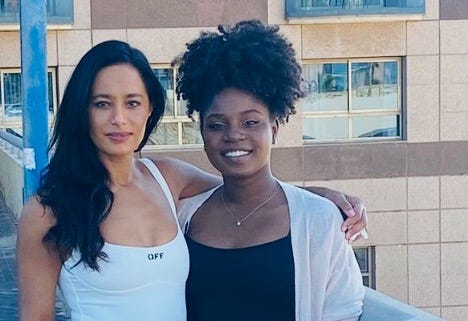
I asked Rula for a photo of her father, but old photos aren’t on her phone, and she sent me these instead, of her two sisters and nieces, and her cousin Musa Qudous, who passed away two years ago while his daughter Shadin was held in Israel’s prison dungeons over a social media post.


I refuse.
I won’t pretend Rula’s word choice was correct, but I know her well enough to know that she did not mean it as it is being sold by the pro-Israel mob. She has already done the harder work of unreservedly owning it, without excuses, and faster than this manufactured fury deserved.
What I refuse to do is let an ongoing genocide—one that has starved children and burned and buried whole families alive, one that Hakeem Jeffries keeps voting to fund—get laundered into a week’s controversy over her word choice, while the atrocity itself disappears from the conversation.
That is the zionist design. It always is, because they have no other defense except distraction.
I think of Ammou Othman filling his pockets with candy before walking out to feed the birds and cats at Al-Aqsa. I think of how a man like that raised a daughter who refuses to look away—not from Palestine, not from what was done to her in Italy, not from anti-Blackness anywhere.
And I think of this week. On September 6, just hours apart during the so-called “ceasefire,” Israeli bombs struck twice in Gaza, while parents were still out gathering the body parts of their children.
I won’t narrate what is in those video clips, except to say that in the second clip, filmed in the morning of the same day as the first, there is a little girl who had dressed in her finest for her first day of school, but her clothes were torn and burned, her limbs twisted unnaturally, and her body lifeless.
That is where the world’s attention should have stayed. Instead it was redirected, on cue by AIPAC, to litigating the words we use for the demons perpetrating this genocide and the monsters in Washington who keep them funded. A single imperfect word from a Black Palestinian woman will always generate more American political outrage than a murdered Palestinian child girl the same day, and more than three years and tens of thousands of dead children like her.
Everyone running this dirty play knows it.
But what is most disappointing are all the Black personalities publicly pillorying a Black woman in ways they’ve never done before in similar moments. The only explanation for the disparity is in the other half of her identity.
Rula Jebreal does not need me to defend her integrity. Her record does that. But I knew her father, and I know where she comes from, and I will not stand by while people who have never once mourned a Palestinian child weaponize anti-Black racism—real, generational, unhealed—to protect a lobby and a leader who cannot say the word genocide.
Shame on them. Not on her.
Susan Abulhawa is a novelist, poet, essayist, scientist, mother, and activist. Her debut novel Mornings in Jenin (Bloomsbury, 2010), translated into 30 languages, was an international bestseller and is considered a classic in Palestinian literature.
RELATED:
- We Analyzed Thousands of News Articles: Here’s the Proof of Pro-Israel Bias in Mainstream Media
- The Real “Divide” Among Democrats Over Israel Is Between Party Leadership and Voters
- Top House Democrats vow to oppose bid to cut US military aid to Israel: 2 Articles
- Corporate Media Go All Out To Support The US-Israeli War On Iran
- The billionaire family poised to rewire U.S. media in Israel’s favor