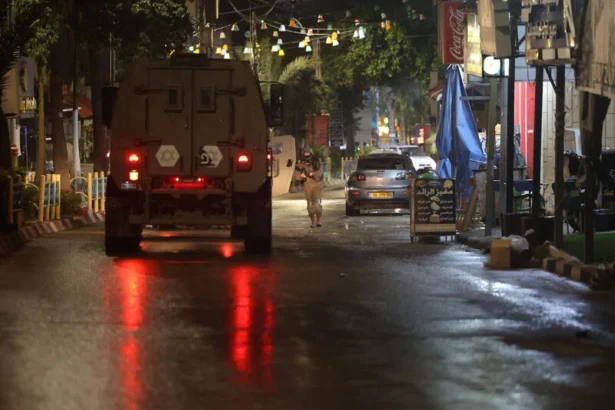
Night raids are a fixture of life in the West Bank, a reality since the occupation began in 1967. The practice has grown even more frequent in recent years.
By Jared Hillel, reposted from Electronic Intifada, September 15, 2026
On a cold winter night in late January, the Israeli army rolled into the Arroub refugee camp, somewhere between Hebron and Bethlehem in the southern part of the West Bank.
An army watchtower looms over the entrance. And around 2:30 in the morning on 25 January, a military raid began.
Unsuspecting families had their doors kicked in, as masked soldiers flooded into homes, destroyed furniture, going room to room in search of a handful of teenage boys. Hassan, 13, was one of the targets, and so was his friend, Ibrahim, 15.
Both asked for their names to be changed, fearing the possibility of a retaliatory arrest.
Refugee camps have been a frequent target for Israeli forces. The most extreme escalation – codenamed Iron Wall by Israel – began in January 2025 and led to the emptying of Jenin, Tulkarm and Nur Shams refugee camps in the northern West Bank.
Over 33,000 Palestinians were forcibly displaced after a weeks-long onslaught which included not only raids, but also home demolitions, torn up roadway and sabotaged water and power infrastructure.
Today, the populations of the three camps remain uprooted, with a recent UN report raising concerns that such large-scale and systemic displacement can amount to a crime against humanity of forcible transfer.
Despite barely being a teenager, Hassan had already been brutalized by Israel’s military. In 2023, he had been shot while walking home from a cafe where he had been playing billiards.
With a boyish grin, he dropped his sweatpants and showed a long scar stretching from the top of his outer leg down his thigh.
Hassan looks younger than his age, and as he tells his story, it’s impossible to imagine how such a small kid could be perceived as a threat. But this past January, the army came after him again – this time in his bedroom.
Once inside the family home, soldiers began shouting in Hebrew, demanding to know where he was. “When I told them I’m Hassan, they grabbed me, slapped me, threw me to the ground and started cursing at me,” he told The Electronic Intifada.
As soldiers dragged Hassan out into the cold, his mother tried handing him a jacket but was prevented from doing so. Standing by helplessly, she watched as the men carried Hassan away into the darkness.
A few homes down, a similar scene was playing out at Ibrahim’s house. Along with the rest of his family, Ibrahim told The Electronic Intifada, the boy was made to stand against a wall, as approximately 20 soldiers held them at gunpoint.
“Before I even finished saying my full name, he grabbed me.”
A soldier also cursed at his sister, he said.
The two kids were thrown into army jeeps and taken away. Their parents had no idea where or whether they would see them again.
Once out of sight, soldiers began kicking and punching Hassan while in the back of the vehicle. In Ibrahim’s case, the driver abruptly slammed on the brakes, sending him flying into the door.
Night raids like these are a fixture of life in the West Bank, a reality since the occupation began. But the practice has grown more frequent in the past years, as unprecedented violence across the Palestinian territories has become the new norm.
Decades of night raids
In the aftermath of the military occupation of 1967, Israel entrenched control over all facets of life in the newly occupied territories via thousands of military orders. Often providing cover for human rights violations, one in particular, the Order Regarding Security Provisions, granted soldiers the power to search or invade homes without needing a warrant.
Such powers are “unparalleled,” according to the Israeli rights group Yesh Din, in any modern judicial system.
Within this “legal” framework, home raids carried out mostly under the cover of darkness became a constant reminder of the army’s presence and power, as the military began to routinely invade homes with little concrete suspicion.
According to Lawyers for Palestinian Human Rights, prior to October 2023 and since 1967, Israel had conducted over 170,000 search or arrest incursions across the West Bank, many of which occurred at night.
Regarding minors, a 2013 UNICEF report found that an estimated 7,000 Palestinian children had been detained, prosecuted and at times imprisoned over the preceding decade. The findings noted that night arrests remained a common method of apprehension, and called on Israel to end the policy.
For Alexandra Saieh of Save the Children, such arrests have lingering effects far after the ordeal comes to an end.
“We’ve heard children say things like they have trouble sleeping after being detained, they are scared of going to bed, they are scared of separating from their parents,” she said.
The UNICEF report did create enough of an outcry that the chief military prosecutor of the West Bank at the time announced a pilot project in which the army would issue written summonses to wanted Palestinians instead.
That pilot program had a scant impact. Six years after the announcement, the Israeli human rights organization Hamoked released new findings on the practice of arresting minors at night, reviewing the use of summons as an alternative to pre-planned invasions.
Based on affidavits from 81 teenage boys who had previously been detained, over 70 percent reported having been arrested at night. Out of the 58 boys who reported being arrested at night, in only one case did the parents receive a summons for interrogation beforehand.
When pressed about the promised reforms, both the military and police claimed to have not collected comprehensive data on the matter. The Hamoked analysis concluded that despite the newly established special procedures, “no effort is made to enforce them and they appear to be no more than a dead letter.”
In a renewed attempt to pressure the army into complying, Hamoked petitioned the Israeli high court to demand that security forces cease arresting minors in the West Bank at night and instead rely on summons via their parents as first recourse. In 2021, in response to the petition, both the military and police announced that they would follow a new procedure that would “minimize the harm to the civilian population.”
The following year, however, data collected by Military Court Watch revealed that out of 50 testimonies from arrested children, half had been detained at night, with a summons issued in only one case.
No let-up
According to figures compiled by the United Nations Office for the Coordination of Humanitarian Affairs (OCHA), over 3,400 search and arrest operations took place across the West Bank in 2022. Not only did this trend show no sign of abating in the leadup to October 2023, raids massively intensified in the aftermath of the attack.
Data shows that in the first nine months of 2025, nearly 7,500 raids were carried out both night and day across the West Bank, marking a 37 percent increase when compared to the same period in 2024, itself a significant increase from 2023.
Alexandra Saieh of Save the Children said that her organization has “not seen any significant reform over the last several decades,” adding that “over the last two years […] the conditions that detained children are facing have actually deteriorated.”
Unsurprisingly, this tactic has also increasingly been used in Gaza. Prior to October 2023, night raids in the territory were sparse, as Israel had withdrawn its soldiers and settlers from Gaza in 2005.
While the enclave would fall under a crushing blockade two years later, and suffered several major military assaults – including in 2008-09, 2012, 2014 and 2021 – residents were at least spared daily encounters with Israeli soldiers.
But since Israel’s genocidal war began, on top of the drone strikes, sniper fire and aerial carpet bombings that have ravaged the Strip, night raids – often targeting children – have become an additional layer of torture residents now face.
While the total number of children arrested in Gaza remains unknown, out of 491 detainees from Gaza who had been arrested after October 2023 and were released as part of a prisoner swap in February 2025, 44 were minors. Accounts from other minors who were apprehended and later released indicate that the true number is considerably higher.
One Amnesty International report detailed the capture and detention of a 14-year-old boy from Jabaliya, northern Gaza, in January 2024. He would go on to be held for over three weeks in the notorious Sde Teiman detention center with over 100 adult detainees, where he said he was physically tortured, including being burned with cigarette butts, and barred from speaking with his parents or a lawyer.
Whether from the West Bank or Gaza, once a child is held by the military – with all that that entails of interrogations rife with human rights abuses – they face an unpredictable fate. According to Palestinian prisoner rights group Addameer, 370 children are currently held in Israeli detention.
Hassan and Ibrahim were fortunate to have avoided long detentions. Despite being subjected to gruelling interrogations, which included beatings, mockery and attempts to coerce confessions, they were returned to their families the following day.
A form of terror
Even in the case of quick resolution, Titi Carmel, CEO of Parents Against Child Detention, an Israeli organization monitoring the conduct of forces occupying the West Bank, said that the trauma of detention and night raids reverberates throughout a child’s life.
Carmel told The Electronic Intifada that the helpless position parents find themselves in during these state-sanctioned abductions “breaks the sense of safety, not only in your home, but also in your relationship with family.”
On top of the inherent cruelty of raiding homes at night, the approach stands in stark contrast to the army’s treatment of Israeli settlers who also reside in the West Bank. Settlers are rarely arrested in the first place – despite the daily attacks they carry out on neighboring Palestinian villages.
According to the UN, in the first four months of 2026 alone there were 190 settler attacks.
And those who do face some accountability are subject to civilian Israeli law.
One of the many disparities in this two-tiered legal system is that settler homes require a warrant to search, with impromptu raids only permitted if security forces believe that a crime is actively being committed on-site.
While Israel maintains that raids are carried out at night to minimize clashes, promises of reform prove the army is well aware of the harm inherent to these arrests, suggesting the tactic serves a more sinister purpose as well.
According to a joint report released by Yesh Din, Breaking the Silence and Physicians for Human Rights Israel, one of the ulterior motives is that of “mapping,” where unannounced invasions are used as a method to collect information about the structure of the home or its inhabitants.
The army has even staged mock raids – including arrests – on families for the sole purpose of training soldiers.
For human rights advocates, the true objective of this practice is evident.
“It creates this environment of fear where your house is not a safe place, you can always be taken and your children can always be taken,” said Titi Carmel, emphasizing that “to me it’s just a form of terrorizing the population and weakening the young generation from rising up.”
This point has been corroborated by former soldiers, who have testified that one of the objectives is to achieve “deterrence”, which is the belief that a scared population is less likely to rebel.
Most damning of all is that many children, including Ibrahim and Hassan, are detained for no more than a day. Israel has long shown that anyone remotely perceived as a threat will be incarcerated for months on end with or without prosecution or trial.
If the army truly believed Ibrahim and Hassan were part of Hamas, were throwing Molotov cocktails or endangering soldiers in any way, the two would have almost certainly faced months of arbitrary administrative detention.
As Hassan was recounting his story, Muhammad, a young man from the Arroub camp who looked in his 20s, watched. Friendly by nature, he stopped by the house and stayed to listen to our interview.
Interrupting Hassan, Muhammad comically impersonated the soldiers, saying they picked up Hassan and carried him over their shoulder “as if he was a purse.”
Everyone laughed, including the young boy.
The raids may have become so normalized that some can even joke about them, but scars linger.
“It makes me feel sad that I have to grow up in such a situation,” said Hassan. Ibrahim compared his experience to that of torture.
Military raids continue to happen on a near-nightly basis, a trend that shows no sign of abating. Indeed, today, even empty promises of reform feel like a distant memory.
Jared Hillel is a journalist based in Jerusalem. He has previously worked with Reuters in London, and was once a radio star in Canada.
RELATED:
- Israeli Soldiers Abduct Many Palestinians in Occupied West Bank
- New Maps Show How Israel Has Thwarted Hopes for a Palestinian State
- Report: Mass Abductions, Torture, Enforced Disappearances
- Gideon Levy: If Anyone Should ‘Not Forget nor Forgive,’ It’s the Palestinians
- West Bank: UN rights report warns of forcible displacement from three refugee camps
- Israel is quietly erasing Palestinian refugee camps from existence in the West Bank
- For daily reports about these see this.