The annexation of the West Bank through settlement, violence and the fragmentation of Palestinian space
Reposted from Yesh Din, Bikmom, and HaMoked, August, 2026
In September 2025, Israel’s Minister of Finance, who also serves as Additional Minister in the Ministry of Defense, Bezalel Smotrich held a press conference together with settlement leaders, where he unveiled a plan to annex 82% of the West Bank. Minister Smotrich declared: “Enemies must be fought, not allowed a comfortable life. Therefore, the overriding principle for applying sovereignty is: maximum land with minimum population.”1
Smotrich presented a map entitled Sovereignty Plan, expressing a vision to push three million Palestinians in the West Bank into six isolated ghettos, while the rest of the territory is reserved for Israelis. The map erases the Palestinian governorates of Bethlehem, Salfit and Qalqiliya, home to more than 450,000 people.2
The Sovereignty Plan proposed by this senior Israeli minister directly follows the trajectory of his Decisive Plan, released in 2017. That policy paper envisioned the annexation of the West Bank coupled with stripping away the national rights of Palestinian residents and presenting them with three options: forgo their national aspirations and live under Israeli rule; emigrate to one of the Arab countries with Israeli assistance; or “be dealt with by the security forces with a strong hand.”3
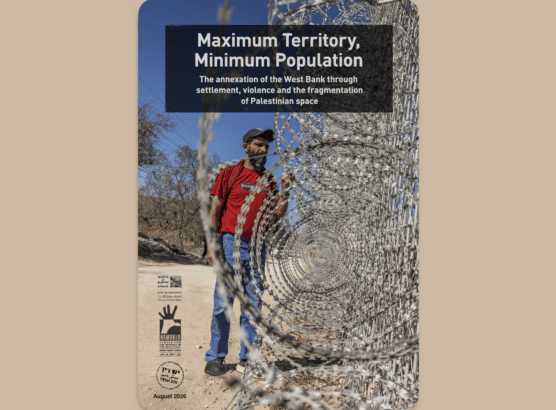
Maximum Territory, Minimum Population demonstrates how Smotrich’s structured doctrine, key parts of which have been adopted as official government policy,4 has been applied by Israel on the ground for years, and with greater momentum since the war in Gaza began in October 2023.
The report presents the diverse practices Israel uses to drive Palestinians out of ever-expanding parts of the West Bank, from single families to communities, towns and entire geographic expanses. Using four case studies that focus on different levels of Palestinians’ social and geographic circles of belonging in the West Bank, the report demonstrates that Israel’s annexation policy is applied at different scales and in different areas in the occupied Palestinian territory (OPT).
The report begins with the stories of two Palestinian farming families whose land Israel trapped between the separation fence and the Green Line, the area known in Israel as the Seam Zone. Since October 2023, Israel has all but barred these families’ access to their land, effectively turning it ownerless. The second section turns the lens onto a Palestinian community living in Area A near Jericho and shows how settlers and soldiers collaborate to extend the transfer apparatus to this area as well.
It then presents the case of the town of Sinjil in the Ramallah district, which Israel has encircled with a fence, checkpoints and violent outposts, thereby significantly reducing the space used by its thousands of residents. The final part of the report focuses on Palestinian space in the northern West Bank, where Israeli control efforts are now focused, as Palestinian residents helplessly watch their bleak future take shape.
The report’s analysis reveals how Israel utilizes an integrated mechanism of military forces and settlers, backed by the government and shielded by law enforcement authorities, to annex the West Bank. The belligerent, brutal means Israel employs to achieve its ambitions in the West Bank are many, varied and interconnected. This report focuses on three of them:
The establishment of outposts deep inside Palestinian areas, aimed at invading and taking over Palestinian land, funded by the government and legitimized and encouraged by elected officials;
Severe violence by soldiers and settlers against Palestinians designed to stop them from accessing their land and pushing them off it, while law enforcement authorities do nothing;
A draconian movement and access regime imposed by the military, composed of checkpoints, fences and orders that restrict Palestinian movement only, undermine Palestinians’ livelihoods and limit their ability to travel from place to place.
Israel is effectively annexing the West Bank through a structured, coordinated policy that integrates settlement, violence and the fragmentation of Palestinian space.
The state of emergency, introduced as temporary, has become a permanent reality used by the State of Israel, through soldiers and settlers, to displace Palestinian communities, push the population into isolated enclaves, and erase the territorial contiguity of Palestinian space in the West Bank, amid mass abuse of Palestinians’ human rights. In this way, the reality Israel has dictated in the OPT in recent years, and especially since October 2023, is steadily realizing the twisted vision of emptying the West Bank of millions of Palestinians and annexing it to Israel.
*You can read the rest of the report here*
1 Zeev Gur Aryeh, “Maximum Territory, Minimum Population: The Judea and Samaria Sovereignty Map”, JDN, September 3, 2025 (Hebrew); Foundation for Middle East Peace, “Settlement & Annexation Report: September 12, 2025”, September 12, 2025; Ben Sokol, “Smotrich proposes annexing 82% of West Bank in bid to prevent Palestinian state”, The Times of Israel, September 3, 2025.
2 IPCC, “Palestine Demographic Profile – Reality and Future scenarios”, October 2024.
3 Bezalel Smotrich, “Israel’s Decisive Plan”, Hashiloach, Issue 6, September 2017.
4 Yesh Din, ACRI, Ofek and Breaking the Silence, The Silent Overhaul: Changing the nature of Israeli control in the West Bank, July 2024; Yesh Din, ACRI, Ofek and Breaking the Silence, Policy paper: What Israel’s 37th government’s guiding principles and coalition agreements mean for the West Bank, January 2023.
Yesh Din – Volunteers for Human Rights, Bimkom – Planning and Human Rights, and HaMoked: Center for the Defence of the
Individual are Israeli human rights NGOs primarily funded by foreign governmental entities
RELATED:
- Annus Mirabilis – Actions by the Israeli Government to Annex the West Bank
- The blatant racism and cruelty that define Israel’s settler movement
- Oxfam: More Palestinians killed by Israel across West Bank in last 3 years than previous 17 years combined
- Israeli General Is Running a Sophisticated, Sociological Engine of Violence
- With World Distracted by War, Extremist Settlers Intensify Attacks in West Bank