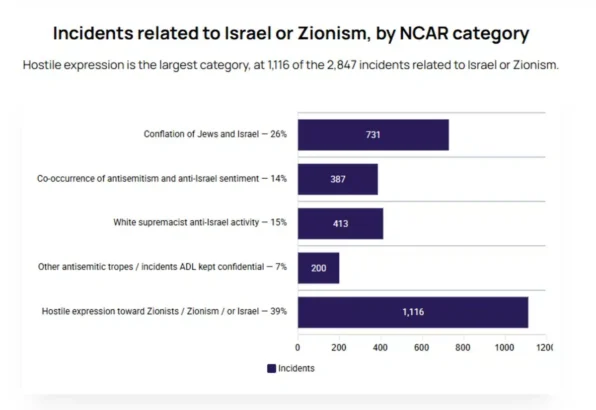
The Anti-Defamation League reports each year on the state of antisemitism in the US. But its audit fails to disclose the fact that roughly 45% of so-called antisemitic incidents are actually anti-Israel or anti-Zionist.
Reposted from The Nexus Center for Antisemitism Research, September 24, 2026
Executive Summary
The Anti-Defamation League’s annual Audit of Antisemitic Incidents is one of the most cited reports on the state of antisemitism in the United States, but it emerges out of ADL’s own ideological definitions, which are not universally held. The Audit’s categorization scheme also glosses over important distinctions between some types of incidents, especially those related to Israel.
Together, these factors limit the Audit’s usefulness. Readers who want reliable data on antisemitism but disagree with ADL’s definition of the term, especially regarding anti-Israel activism, may dismiss the entire dataset as biased. Policymakers, educators, and community leaders who base their understanding of antisemitism in America today on the Audit may have a harder time developing effective strategies because they are missing details trapped in the Audit’s overly broad categories.
To help draw out more detailed patterns in the ADL data, the Nexus Center for Antisemitism Research (NCAR) examined ADL’s publicly posted dataset for the 2025 Audit — 6,274 incidents — and applied its own thematic taxonomy to the 2,847 incidents (45%) that ADL categorized as related to Israel or Zionism. NCAR did not add or remove any incidents, and this analysis relies solely on information ADL has made public.
This analysis in no way seeks to downplay contemporary America’s historically high levels of antisemitism or suggest that any incident in the Audit is unworthy of serious concern. On the contrary: by elucidating what the Audit dataset actually contains, this analysis will make the Audit more useful for policy and more trusted by the people best positioned to act on it.
Key Findings
- 12% of the Audit (731 incidents) consists of incidents where perpetrators conflated Jews or Jewish institutions with the State of Israel: In 731 incidents, Jewish people were harassed or assaulted, or their property was vandalized, apparently by people who were motivated by anger towards Israel or Zionism.
- 18% of the Audit (1,116 incidents) consists of hostile expressions about Zionists, Zionism, or Israel that ADL considers antisemitic: These incidents include support for terrorism 279 (4.4%), general anti-Zionist statements 281 (4.5%), calls for “resistance” 208 (3.3%), “From the River to the Sea” 197 (3.1%), calls for “intifada” 154 (2.5%), Nazi comparisons 80 (1.3%), calls for Zionists to be killed 24 (0.4%). Categories are not mutually exclusive. By including an incident in one of these categories, NCAR is not saying that it is not antisemitic — merely that it has different thematic elements, and some phrases are open to multiple interpretations.
- 13% of the Audit (roughly 790 incidents) consists of rally rhetoric about Israel or Zionism, not direct harassment of Jews: Roughly 790 incidents were included because of chants, signs, or speeches at anti-Israel rallies that ADL deemed antisemitic, ranging from “From the River to the Sea” to expressions of support for Hamas. ADL’s descriptions of these incidents record no targeting of Jewish people or institutions and none of the classic antisemitic tropes, slurs, or symbols described in this report. These make up the large majority of the 883 incidents that took place at anti-Israel rallies. The remaining roughly 100 involved rally-goers targeting Jews or Jewish institutions, including 28 protests staged at synagogues and other Jewish institutions, expressing classic antisemitic tropes or slurs, or conflating Jews with Israel; among them were a handful of physical confrontations and about 20 cases of direct harassment of Jewish people. (NCAR identified 883 rally incidents in the dataset; ADL’s published figure is 856.)
- Most rallies in the Audit took place in public areas such as streets and parks, not on campuses or at Jewish institutions: Of the 883 rally incidents, 165 (19%) occurred on campus and 28 (3%) at Jewish institutions. The rest took place on streets, in parks, and at transportation hubs and government buildings.
- Campus incidents are concentrated; campus rallies were not violent: The 583 campus incidents (72% Israel-related) took place at at least 214 identifiable colleges and universities — about 8% of the nation’s four-year institutions, though these include many campuses with large Jewish enrollment. 148 of those campuses (69%) experienced two or fewer incidents; the highest, Columbia University, had 15. A bit more than a quarter of campus incidents (165) took place at anti-Israel rallies; approximately ten of these included direct harassment of Jews or attempts to disrupt Jewish events, with the rest included because of statements, chants, or slogans. By ADL’s own measure, none incorporated violence. Separately, 37 incidents occurred in student housing, the vast majority with no Israel connection: swastikas, Nazi references, slurs, and Mezuzot torn from doorways.
NCAR researchers manually coded every Israel-related incident and developed a detailed protocol; two large language models then independently applied it to surface inconsistencies and difficult cases, and every disagreement was resolved by human review, with a spot-check of about 10% of classifications. The author worked at ADL for 18 years, including as director of its Center on Extremism, but this report is not based on any of ADL’s proprietary data. See the Methodological Note below for details.
Introduction
The Anti-Defamation League’s annual Audit of Antisemitic Incidents is one of the most cited reports each year on the state of antisemitism in the United States. It tracks incidents of antisemitic vandalism, harassment, and assault, and it uses categories to illustrate the problem of antisemitism and where it occurs. But the Audit can also be a controversial document, employing inclusion criteria that others in the American Jewish community disagree with, and relying on analytic categories that do not capture important fact patterns within its own data.
Much of the controversy around the Audit hinges on ADL’s decision to categorize all the diverse types of incidents in its dataset as “antisemitic” — a term with a broad range of meanings. Research has shown that people interpret the word “antisemitism” in markedly different ways, with the sharpest disagreement over what kinds of criticism of Israel or Zionism should qualify.
Over the past decade, ADL has taken an increasingly expansive view, adopting the position in 2022 that anti-Zionism is fundamentally antisemitic, and announcing in 2023 that it would include certain types of anti-Zionist expressions in the Audit. This tracks with ADL’s emergence as a champion of the IHRA definition of antisemitism, which characterizes several forms of criticism of Israel and Zionism as antisemitic. Other definitional frameworks exist, however, including the Nexus Document, which draws finer distinctions on some of the most contentious issues related to antisemitism and criticism of Israel/Zionism. The Audit, then, and its use of the term “antisemitic incident,” emerge out of ADL’s own ideological position on what antisemitism is.
It is not possible to comprehensively determine which of the Audit incidents comport with other frameworks for defining antisemitism, mostly because ADL does not provide enough information on specific incidents. The ADL Audit dataset — which, to its credit, ADL posts on its website — typically gives a brief, one- or two-sentence description of each incident: usually enough information to indicate why ADL included it, but not enough to enable readers to apply more context-sensitive criteria for what should be considered antisemitic under other definitions or their own beliefs.
ADL’s approach to defining antisemitism, coupled with an Audit that provides little context about individual incidents, may undermine the Audit and miss an opportunity to fight antisemitism effectively and address other concerns of American Jews. In particular, the Audit does not offer quantitative breakdowns of more detailed patterns within its Israel-related incidents — breakdowns that could help readers better understand the landscape of antisemitism in contemporary America.
Combining many different types of incidents can make it harder to develop policy or educational responses to specific challenges facing the Jewish community, and it may alienate people who are committed to helping Jews thrive in this country, but who disagree with some of ADL’s ideological positions or methodological choices. The result is an Audit that may be less useful — or even counterproductive — for policy discussions, and less trusted by the people best positioned to act on it.
To fill this gap, the Nexus Center for Antisemitism Research (NCAR) examined in detail ADL’s dataset for the 2025 Audit of Antisemitic Incidents. The Audit was released in May 2026, and covered incidents that occurred in the United States in the 2025 calendar year. We paid special attention to the incidents in the Audit which ADL categorized as being related to Israel or Zionism — 2,847 incidents out of a total of 6,274, or nearly half of the Audit. We created and applied our own categorization system to the data, which is explored below. In doing so, we make plainer how ADL defines antisemitism; more importantly, we reveal additional insights into the landscape of incidents across the U.S. that affect Jews, regardless of whether they meet any single definition of antisemitism.
It is important to note that nothing in this analysis is intended to downplay the historically high levels of antisemitism in the United States or suggest that any of the incidents in the Audit are not worthy of serious concern. Our goal is to provide a clearer understanding of ADL’s dataset by helping elucidate themes and categories in the data that ADL itself does not provide.
RELATED:
- Why the Mainstream Media Should Stop Using the ADL as Their Go-To Antisemitism Source
- Antisemitism? Really? The 33 Most Absurd Examples Listed in the ADL’s New Database
- ADL’s Stats Twist Israel’s Critics Into Antisemites
- ADL faces Wikipedia ban over reliability concerns on Israel, antisemitism
- Anti-Defamation League (ADL) again sides with human rights abusers over free speech on campus
- ADL trying to exploit movement for ‘socially conscious investment’