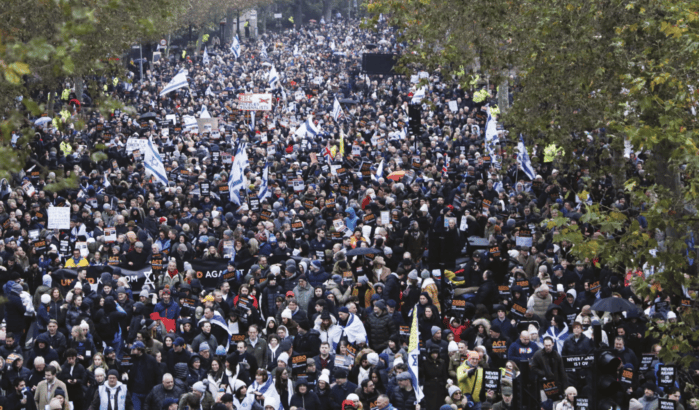
Zionists are pursuing a two-pronged strategy in Britain, capturing the political class while casting the Palestine movement as enemies of ‘the people’. The left should be more radical in fighting back.
By Matt Kennard, reposted from Tribune , August 10, 2026
In July 2016, the veteran Conservative politician Alan Duncan was slated for a promotion at the Foreign Office. ‘All seems clear and agreed that I will be Minister for the Middle East, as expected’, he wrote in his diary. ‘Permanent Under-Secretary Simon McDonald called to say it’s all been agreed and he would recommend it to the Foreign Secretary.’
Later that day the plan was suddenly upended. Foreign Secretary Boris Johnson told Duncan that word had got out about the move and that ‘Conservative Friends of Israel are going ballistic’. Johnson reported that senior figures in CFI, Eric Pickles and Stuart Polak, had ‘both called him incessantly’ to demand the appointment be rescinded. Duncan’s crime? His vocal support for a two-state solution: the official position of the UK government.
Soon after, Prime Minister Theresa May told Johnson that Duncan had been vetoed; he instead took up the role of Minister for Europe and the Americas, for which he was considerably less qualified. ‘The Israelis think they control the Foreign Office’, he later remarked to McDonald. ‘And they do!’
At first sight, this looks like a classic case of the people versus the elite. A foreign state is able to control who gets a job in the British state, rendering the democratic will entirely irrelevant. While only 12 percent of Britons now say they sympathise with Israel, the material effect on government policy is negligible. Labour cannot bring itself to enforce even the most minor, symbolic suspension of weapons licenses. Lethal fighter jet components continue to flow freely while British spy planes have been dispatched to assist Israeli intelligence.
Most analyses of the Israel lobby (meaning the loose, informal grouping of organisations whose activities advance Israeli interests) tend to stop here, assuming that its function is simply to insulate decision-making from the masses. But this is only half the story. In fact, the lobby’s response to Israel’s growing unpopularity is not just to co-opt political elites and protect them from popular pressure, but to pursue a ‘populist’ strategy of their own — one that has proven highly effective. By presenting pro-Palestine sentiment as the mark of untrustworthy outsiders to the British nation, allies of Israel have tried to divide, disorientate and defang large parts of the solidarity movement. In so doing, they have become part of a disturbing new political alignment, finding common ground with the rising right-wing populism represented by Nigel Farage and Tommy Robinson.
The narrative spun by the lobby presents opposition to genocide as a conspiracy of left-wing wokery in alliance with Islamist sectarianism: alien forces arrayed against the true, national people. Palestine solidarity is not a democratic movement confronting concentrated power and violence, but a foreign virus infecting Britain’s body politic. Zack Polanski — the pro-Palestinian Jewish leader of the Green Party, with his Muslim deputy Mothin Ali — has become the principal villain of this story.
The Israel lobby can therefore face both ways. It can reassure Conservative and Labour politicians that they need not pay much notice to public opinion. But it can also stage a conflict between Western civilisation and its Others, exploiting conditions of secular decline and racial angst to persuade ordinary people to identify themselves with Israel, as an embattled fortress in the savage wilderness.
This piece will map both sides of the Israel lobby’s dual strategy, its simultaneous address to the elites and to the people, showing how its peculiar ability to marshal allegations of racism in the defence of genocide and Islamophobia gives it a special salience for right-wing forces. The implications here are stark, overturning many of the ‘pragmatic’ or ‘common sense’ positions on the left. To counter this pernicious influence and defend the wider possibility of radical politics, we will have to reject the standards of acceptable opinion that the Israel lobby tries to set, and instead embrace a resolute anti-Zionist position.
Political Capture
How did what Duncan described as the ‘entrenched espionage’ of the Israel lobby become so ubiquitous in Britain? The answer goes back more than a century. Lobbying has been a major focus of the modern Zionist movement since its earliest days, with leaders including Theodor Herzl himself recognising that they could not bring about their outlandish idea of replacing Arab Palestine with Jewish Israel without the backing of the imperial powers.
Chaim Weizmann, the Belarussian chemist who settled in Britain and went on to serve as the first president of Israel, spent years cultivating relationships with key UK officials, especially Foreign Secretary Arthur Balfour and Prime Minister David Lloyd George. He later played a role in drafting the Balfour Declaration which eventually gave the Zionist movement the Palestinian land they coveted. After the establishment of Israel in 1948, the same forces were mindful that the countries of the core would have to provide significant military and economic support to maintain this tiny, peripheral settler entity in what was then a hostile region. A network of campaigners and pressure groups developed to secure it.
This external scaffolding has become even more essential as Israeli politics has radicalised in recent decades. The priorities of the colonial project have now shifted from domination — maintaining an apartheid system in Palestine while steadily expanding its territorial control — to outright extermination: seeking to destroy the very foundations of human life in Gaza and gearing up for the complete annexation of the West Bank, while raining bombs on Iran, Lebanon, Syria, Qatar and Yemen. This has come alongside all manner of barbarities on the domestic front, including the new mandatory death penalty for Palestinians and the routine torture and gang rape of detainees. There are parts of the lobby that appear to reckon, reasonably enough, that continued support for such a state can only be assured through the capture of high politics.
The groups that are most explicit about this ambition are the ‘Friends of Israel’ groups embedded in all the major UK parties, excluding the Greens. Perhaps the most effective in recent years has been Labour Friends of Israel. Founded in 1957, LFI has long advanced its cause by taking politicians on carefully curated tours of Israel, where they can present them with a pre-packaged version of the Zionist project, and maintaining close contact with them thereafter, through meetings, briefings, campaigning initiatives, policy papers and the like. LFI tends to target new-intake MPs as well as other high-level figures who have not yet entered politics.
The group paid for Rachel Reeves to visit Israel in 2005 while she was working at the Bank of England, five years before she entered parliament. In 2011 she went on a so-called ‘fact-finding visit to Israel and the Palestinian territories’, with costs covered by LFI and hospitality provided by the Israeli Foreign Ministry. LFI sent Reeves to Israel again in 2014, and she would later become the organisation’s vice-chair. Flash forward to December 2025 and Reeves is addressing LFI’s annual lunch, telling the crowd that she considers herself an ‘unapologetic’ Zionist and denouncing ‘dark conspiracies about the supposed power of the “Zionist lobby”’, while her government continues to provide arms and intelligence to the military raining hellfire down on Gaza.
Though LFI does not disclose its funders, in 2017 undercover reporters from Al Jazeera captured its then parliamentary chair Joan Ryan talking to an Israeli embassy official called Shai Masot about a payment of ‘more than one million pounds’. Masot was later forced to resign after footage from the same documentary exposed him plotting to ‘take down’ sitting British MPs including Duncan. Reporters also recorded LFI parliamentary officer Michael Rubin remarking that he and Masot ‘work really closely together. . . . but a lot of it is behind the scenes’. Rubin, who has since become LFI’s director, added that ‘the [Israeli] embassy helps us quite a lot. When bad stories come out about Israel, the embassy sends us information so that we can counter it.’
Keir Starmer and most of his senior cabinet, including deputy leader Lucy Powell and foreign secretary Yvette Cooper, were ‘parliamentary supporters’ of LFI — although the group’s list of backers was wiped from its website after the start of the genocide. Wes Streeting was Starmer’s first shadow minister to visit Israel in 2022 at LFI’s expense, meeting with ‘politicians, academics and diplomats’, and lauding the Israeli health service as ‘ten years ahead of the NHS’. It is reported that he continues to meet regularly with LFI representatives in Westminster.
Andy Burnham was among the group of Labour MPs who signed up to LFI in 2016 reportedly in protest at Jeremy Corbyn’s election as leader. His principal adviser in his three former ministerial roles, Jennifer Gerber, became the director of LFI immediately after Labour lost the 2010 election, and served in the role for a decade. Burnham has railed against what he called ‘unjustified spitefulness’ towards Israel and praised the country as a beacon of civil liberties.
We Stand With Israel
LFI thus collaborates with key Israeli officials and wields its considerable financial resources to cultivate prominent politicians via trips to Israel — building relationships which help to shape elite opinion and make it easier to intervene against Palestine solidarity. Conservative Friends of Israel operates in a similar way, inducting new Tory MPs early in their career, including rising stars like Boris Johnson, who was sent to Israel in 2004 for a trip jointly funded by CFI and the Israeli government. CFI has claimed that 80 percent of Conservative MPs are members. It too does not disclose its funders.
Determined to style itself as a credible party of government, Reform UK has now launched its own Friends of Israel organisation headed by Jason Pearlman, who until December 2025 was a media advisor to the Israeli President. Many of Reform’s other senior figures are invested, politically and financially, in the Zionist project. Its chief advisor on global affairs, Alan Mendoza, is the president of the UK branch of the Jewish National Fund, whose primary purpose is to fund Israeli settlement projects. The party’s largest donor, Christopher Harborne, is the major shareholder in a defence company that exports weapons to Israel. And its most prominent politician after Farage, Robert Jenrick, has taken huge sums of money from a shipping firm that supplies Israel with arms. Jenrick has argued that the Star of David should be displayed at every entry point to the UK to show that ‘we stand with Israel’.
While LFI and its equivalents focus mainly on building links with politicians, there are other groups which have a broader remit. These include the Jewish Labour Movement (JLM), which acts as a conduit between the Labour Party and the Zionist movement. JLM states that its top objective is to ‘maintain and promote Labour or Socialist Zionism as the movement for self-determination of the Jewish people within the state of Israel’. It is ‘affiliated’ to the UK’s Zionist Federation and ‘organises’ within the World Zionist Organization — the umbrella-group that runs Israel’s Settlement Division, the driving force behind the ethnic cleansing of the West Bank.
Over the course of its long lifespan, JLM has worked to appoint its members to positions of influence in Labour and in local government. Its purpose became most apparent in the mid-2010s, when it embarked on an internal restructure and expanded its engagement with the Labour Party in order to wage all-out war on Corbyn. Its newly appointed director, Ella Rose, had come straight from working as Public Affairs Officer at the Israeli embassy in London, and admitted to having close ties to Masot. She dedicated herself to denouncing what she alleged was widespread antisemitism in the party, claiming that Corbyn was ‘siding with the abusers’ of Jewish communities.
Speaking For the Community
Some lobby organizations act as both Jewish communal groups and dogged advocates for Israel, allowing them to present their views on the latter as representative of the country’s entire Jewish population. The most prominent is the Board of Deputies of British Jews (BoD), which calls itself the ‘British Jewish community’s only democratically elected, cross-communal representative body’. It describes its role as ‘articulat[ing] the concerns and positions of our community on Israel to parliamentarians, the Foreign & Commonwealth Office, media and other faith groups’, and pursuing a ‘programme of engagement with embassies’ that ‘encompasses ties between other countries and the State of Israel’.
The Board’s 2020 annual report noted its ‘close working relationship with the Embassy of Israel in the UK’ and ‘strengthened links to the Israeli Ministry of Strategic Affairs and the IDF Spokesperson Department’. The group appears to have had considerable success in impressing its positions on top UK government officials. Under the Tory–Lib Dem coalition, for example, it paid a visit to Foreign Secretary William Hague to discuss ‘concerns about a potential Palestinian Authority move at the UN for recognition of a Palestinian state’. Soon after, Britain abstained on a UN General Assembly motion in which the majority of the world voted in favour of Palestinian statehood.
The BoD was instrumental in whipping up hysteria about the ‘antisemitism crisis’ in Corbyn’s Labour, issuing constant denunciations of the leadership for supposedly failing to deal with anti-Jewish prejudice or adopt the IHRA definition of antisemitism (which famously conflates it with opposing Israel). If ever the government of the day steps out of line, the BoD is excoriating in its response. When Starmer bowed to public pressure and suspended a small number of arms licenses for Israel, the group lambasted ministers for ‘sending a dangerous message to Hamas and other adversaries of the UK’. Should BoD members themselves deign to criticise Israel, the reaction is even more ferocious: in June last year, five of its deputies were suspended for signing an open letter that took issue with the scale of the violence inflicted on Gaza.
The BoD thus tries to demarcate the limits of opinion for Jews and non-Jews alike. It is helped in this task by the Jewish Leadership Council (JLC), another organisation that purports to be a neutral community institution, whose leading figures include hardline Zionists like Lord Finkelstein and Sir Trevor Chinn. Along with the BoD, it co-founded an organisation called the Fair Play Campaign Group, whose stated aim is to ‘coordinate activity against boycotts of Israel and other anti-Zionist campaigns’, acting as a hub that ‘keeps an eye out for hostile activity so it can be an early-warning system for pro-Israel organisations in the UK’. In recent years, the JLC has urged the government to oppose the ICC’s attempts to rule on the Gaza genocide, to push back against ‘anti-Israel bias’ at the UN, and to heed ‘concerns’ over the funding of UNRWA.
The JLC has long worked in tandem with the British Israel Communications and Research Centre (BICOM), a self-described research organisation that supposedly provides ‘analysis and briefings on Israel and the Middle East’. Its chief executive, Richard Pater, served in the Israeli military during the Second Intifada and subsequently spent fifteen years as a reservist before becoming a senior press officer within the Israeli Prime Minister’s Office. He now brags that he ‘regularly briefs UK journalists’ on issues related to the region. The editor of BICOM’s journal, Calev Ben-Dor, previously worked in the Policy Planning Division of Israel’s Foreign Ministry. BICOM uses such connections to fly UK media and political figures to Israel, forge connections between them and senior Israeli officials, and transmit the official Israeli line through constant policy papers and press releases.
The Antisemitism Weapon
Together, the BoD, JLC and BICOM form a powerful bloc that helps to keep the establishment in check. Yet, influential as they are, these lobbying operations directed at the political class by no means represent the full extent of the lobby. Their elite activities are enabled by ‘civil society’ groups that operate at mass level: either making the case for Israel’s virtues among broad constituencies, or, more often, by attacking and discrediting opponents as antisemites.
Take the Union of Jewish Students (UJS). Though it claims to be the voice of Jewish students, its activities reflect a different agenda. Like the JLM, UJS is affiliated to the World Zionist Organization. It has run a series of ‘Israel campaigns’ such as ‘Bridges Not Boycotts’ and ‘Exploring Zionism’, with the aim of ‘championing the Jewish people’s right to national self-determination’. Notorious for agitating against student-led Palestine solidarity campaigns, it tried relentlessly to delegitimise the peaceful encampments which proliferated during the Gaza genocide. UJS President Edward Isaacs demanded that universities take ‘decisive action’ against them, warning that ‘red lines need to be drawn’. The Union’s claim that the protests had created a ‘hostile and toxic atmosphere’ was cited by politicians arguing for a US-style crackdown.
Other groups purportedly set up to fight antisemitism engage in similar practices. The Campaign Against Antisemitism (CAA) describes itself as ‘a volunteer-led charity dedicated to exposing and countering antisemitism through education and zero-tolerance enforcement of the law.’ One of its methods is to pile pressure on cultural institutions that give platforms to pro-Palestine speakers in the hope of toxifying them among the public. It urged Birkbeck University to cancel a talk by the respected Israeli historian Ilan Pappé, labelling him an ‘overtly inflammatory speaker’ for his contention that ‘anti-Zionism is not anti-semitism’. When Misham Harriman, the chair of the Southbank Centre, called for ‘liberating Palestine’, the CAA accused him of using ‘hateful political language’ which fosters ‘extremism’. Since 2023 the group has made constant efforts to get the government to criminalise pro-Palestine protests. Last year it provided what it described as a ‘detailed dossier’ of information on Palestine Action to the Home Office, calling for its proscription under the Terrorism Act.
The Community Security Trust (CST) is another such group which, with the help of £18m of annual UK government funding, claims to keep an impartial record of antisemitic incidents in Britain. Its reports are widely cited as the most authoritative source on this issue. But in fact it appears to include expressions of anti-Zionism in its tallies. Its 2025 Antisemitic Incidents Report noted that ‘There were 1,766 antisemitic incidents that showed explicitly anti-Zionist motivation, comprising 48 percent of the annual total. . . . CST recorded 462 instances of anti-Jewish hate wherein the terms “Zionism” or “Zionist” were used, often as euphemisms for “Jewishness” and “Jew”’.
By wielding the ‘antisemitism’ weapon, this consortium of so-called charities and campaign groups manages to stifle public expression and create conditions of moral panic, which the government can then use to justify its mounting legal restrictions on criticism of Israel: banning protests, outlawing slogans, arresting activists and charging them with terror offences. The demands of these well-funded operations are amplified by a compliant media, supported by politicians, and eventually used as the basis of state policy. Thus is the popular cause of Palestine recast as a fringe pet-issue of hate-fuelled bigots, who must be forcibly repressed.
The Lobby and the Right
Israel’s ability, given its post-Holocaust history, to frame anti-colonial politics as a racist attack on a small minority community gives its allies a distinctive advantage. Because left-wingers don’t want to be racist, they find the accusation of antisemitism especially demobilising. This in turn creates a perfect alignment of interests between allies of Israel and wider right-wing forces seeking to ensure that popular discontent with years of stagnation and decline do not find expression on the pro-Palestine left, but rather in anti-immigrant and Islamophobic populisms.
The recent experience of the Greens is a telling case study. While the party doesn’t yet have a Friends of Israel organisation, it does have an internal group called the Jewish Greens. Its secretary, Sam Alston, was previously a staffer at Yachad, a liberal-Zionist NGO which has been funded by Trevor Chinn (Alston is also a former representative on the BoD). At the party’s 2026 conference, Palestinian members brought a motion that would have formally committed the party to anti-Zionism. The Jewish Greens forcefully opposed it, claiming that it amounted to an ‘attack on Jewish identity’. One of the group’s officers, Andrée Frieze, averred that ‘to deny Jews self-determination and the option to have their own nation without any consultation is antisemitic’. Amid fierce infighting, the vote was eventually delayed.
The episode coincided with a mounting attack on the party’s Palestine solidarity, which intensified when Zack Polanski criticised police violence in arresting a knife-wielding attacker on the streets of Golders Green. Up until then, the Greens’ old guard had kept publicly quiet as their party was taken over by the energetic ‘eco-populist’ wave. Yet amid a national outcry about violent antisemitism, that changed. Polanski, the only Jewish leader of a major party, was harangued and assailed, accused of being soft on antisemitism. Journalists began writing of antisemites lurking in Green ranks. Caroline Lucas, a former leader and perhaps the closest thing the Greens have to a party grandee, called for ‘immediate action’.
As the Prime Minister called Polanski ‘disgraceful’ and Labour published political attack ads, the Green leader’s personal approval rating dropped fourteen points in one week. A media campaign treated him as the face of evil. Members and candidates accused of antisemitism were presented as ‘the tip of the iceberg’ for a general problem in the party, symbolised — of course — by its Muslim deputy leader.
The explanation was clear. Since winning the Gorton and Denton byelection by uniting downwardly mobile (white) graduates with Muslim voters, the Greens have come to represent — as Corbyn once did — the feared ‘outsiders’ to the nation: out-of-touch cosmopolitans and their trojan horse of racialised communities. While Polanski was attacked for his response to the Golders Green stabbings, Farage wasted no time in rushing to the scene of the crime. He appeared there with smiling fans, and warned that ‘we are importing terrorists’ through migration across the English Channel. He claimed that Iran and the Muslim Brotherhood were seeking to foment attacks to weaken Britain. Political elites, he continued, do not act to protect Jews because they are too busy ‘pandering to’ and ‘appeasing a certain section of the electorate’. When a man who reportedly had a habit of doing Nazi salutes calls for antisemites to be deported, something curious has happened in our political culture.
One step further to the right, Tommy Robinson was engaging in similar tactics. He sat down for a friendly interview with Israeli media, which earnestly compared him to Winston Churchill. ‘We are very close to a school massacre’ of Jews in Britain, he warned, because police do not protect Jews for fear of ‘offending Muslim communities’. Soon after, when Kemi Badenoch called for a pro-Palestinian march to be banned in order to protect Jews, but for Robinson’s march on the same day to go ahead, all these dynamics collided. There was no longer any doubt: ‘protecting Jews’ had become the alibi for right-wing attacks on Muslims and the left, an attempt to place them on one side and ‘the people’ on the other.
Limits of Criticism
One way of measuring the lobby’s success is the extent to which these strategies succeed in shrinking the political space within the Palestine movement itself. There is now a large ecosystem of groups in Britain set up to advocate for Palestinians: organising marches and vigils, calling to hold Israeli leaders accountable for war crimes, exposing the collaboration of the UK government, and delivering vital aid. But among them are a number of actors that end up replicating the policing of opinion that we see from pro-Israel forces. One of the major faultlines here is Zionism. While it is acceptable to demand an end to Israeli atrocities, it is still impossible in many quarters to criticise the driving force behind them: a racist, ethno-nationalist ideology based on expelling or otherwise erasing Arab populations.
Among the most famous examples from the Corbyn years was the trajectory of the Guardian’s Owen Jones, who went from being a prominent supporter of the Labour leadership to part of the chorus of commentators attacking it over its handling of alleged antisemitism. In 2017, Jones gave a set-piece speech at an event hosted by JLM in which he discussed the dangers of ‘left-wing antisemitism’, effectively legitimising the lobby group and the wider smear campaign with his suggestion that those trying to rebut the accusations were failing to ‘listen to victim experience’. (During the same period he posted a video in which he said ‘it’s not helpful to just bandy around “Zionist” and “Zionism”’ because ‘they lack precision as terms, which therefore can cause hurt and distress’.) Since the beginning of the genocide Jones has played a more positive role in resisting pro-Israeli propaganda and drawing attention to the situation in Gaza. But the fact that he could succumb to the lobby’s onslaught at such a crucial political moment, when others were in the trenches trying to fight back, speaks to the strength of this ideological forcefield.
The same could be said of the group Na’amod, which describes itself as ‘a movement of Jews in the UK seeking to end our community’s support for Israel’s occupation and apartheid’. It has helped to push back against the spurious conflation of Judaism and Zionism, attracting media attention with its Jewish-led protests against the slaughter of Palestinians. But when it comes to Zionism, Na’amod is more equivocal: conceding that the term has meant ‘expulsion, discrimination, and violence’ for Palestinians, yet claiming that ‘the historical origins of Zionism as an idea are different to many other forms of colonialism’. This is a wilfully inaccurate reading of a movement that, from the very beginning, has modelled itself explicitly on other successful settler colonial projects. Na’amod maintains a similar ambiguity on the demand for Boycott, Divestment, Sanctions (BDS), stating that it ‘does not take a common position’ on the subject. Nor will it endorse Palestinian proposals for a just settlement in the region; it affirms that it is up to ‘Palestinians and Israelis to determine as equal partners how they will live together and share the land’, giving the oppressors the same authority as the victims in deciding the future of their historic homeland.
Na’amod might argue that these positions are carefully calibrated to win over members of the Jewish community and build a broad progressive front. But in our current political climate the effect is the opposite: creating damaging divisions within the Palestine movement between those who stick to the approved script and those who stray from it. These are precisely the divisions that pro-Israeli interests can exploit to put advocates of Palestine on the wrong side of the populist binary — banding together with the far right to defend the ordinary people of ‘the West’ from the plague of antisemites. It is too early to tell whether the Greens will fall victim to this strategy. The only way to resist it, and to open up the space for genuinely transformative politics in Britain, is to reject any compromise with the lobby’s standards of legitimate opinion. We should not indulge the moral panic over antisemitism or the restrictions on criticizing Israel. We should instead develop a radical anti-Zionist politics to displace them.
Matt Kennard is a Staff Writer at Tribune.
RELATED:
- Israel takes its war on Palestine into the AI age
- “Board of Peace” Billionaire Backs AIPAC Fund Targeting Pro-Palestine Candidates
- Pro-Israel Groups Want You to Believe That Israel’s National Security Minister… Doesn’t Represent Israel
- The Most Important Book of 2026: Clifton and Lustick’s “Israel’s Lobby”
- Against Our Better Judgement